By Engr. Muhammad Bilal — Civil Construction Guide
Choosing wooden doors in Pakistan requires more than choosing a colour. This engineering-led guide compares twelve catalogue designs, solid timber and engineered materials, frames, panels, finishes, installation and buying checks. The accompanying CCG illustrations are conceptual; verify actual manufacturer specifications before purchase.
Contents
- Engineering Semi-Solid
- Classic Panel
- Solid Deodar (Diyar)
- Solid Ash
- Solid Oak
- Solid Mahogany
- Engineered Flush
- HDF Moulded
- Plywood / Blockboard
- Teak Veneer
- Wooden Glass Panel
- CNC Grooved
Wooden Door Types and Designs in Pakistan
How to use this guide: Select a door by location, moisture exposure, security, construction and budget. The brochure images are design concepts; their illustrated dimensions, cross-sections and durability claims are not verified product specifications.

1. Engineering Semi-Solid Wooden Door
Construction: Timber perimeter frame with intermediate core members and MDF, plywood or HDF faces. Semi-solid is a marketing term, so require a cut-section sample.
Recommended application: Dry interior rooms; performance depends on core and edge reinforcement.
2. Classic Panel Wooden Door
Construction: Stile-and-rail panel design available in solid timber or engineered constructions. Appearance does not prove the species or core.
Recommended application: Traditional interiors and drawing rooms.

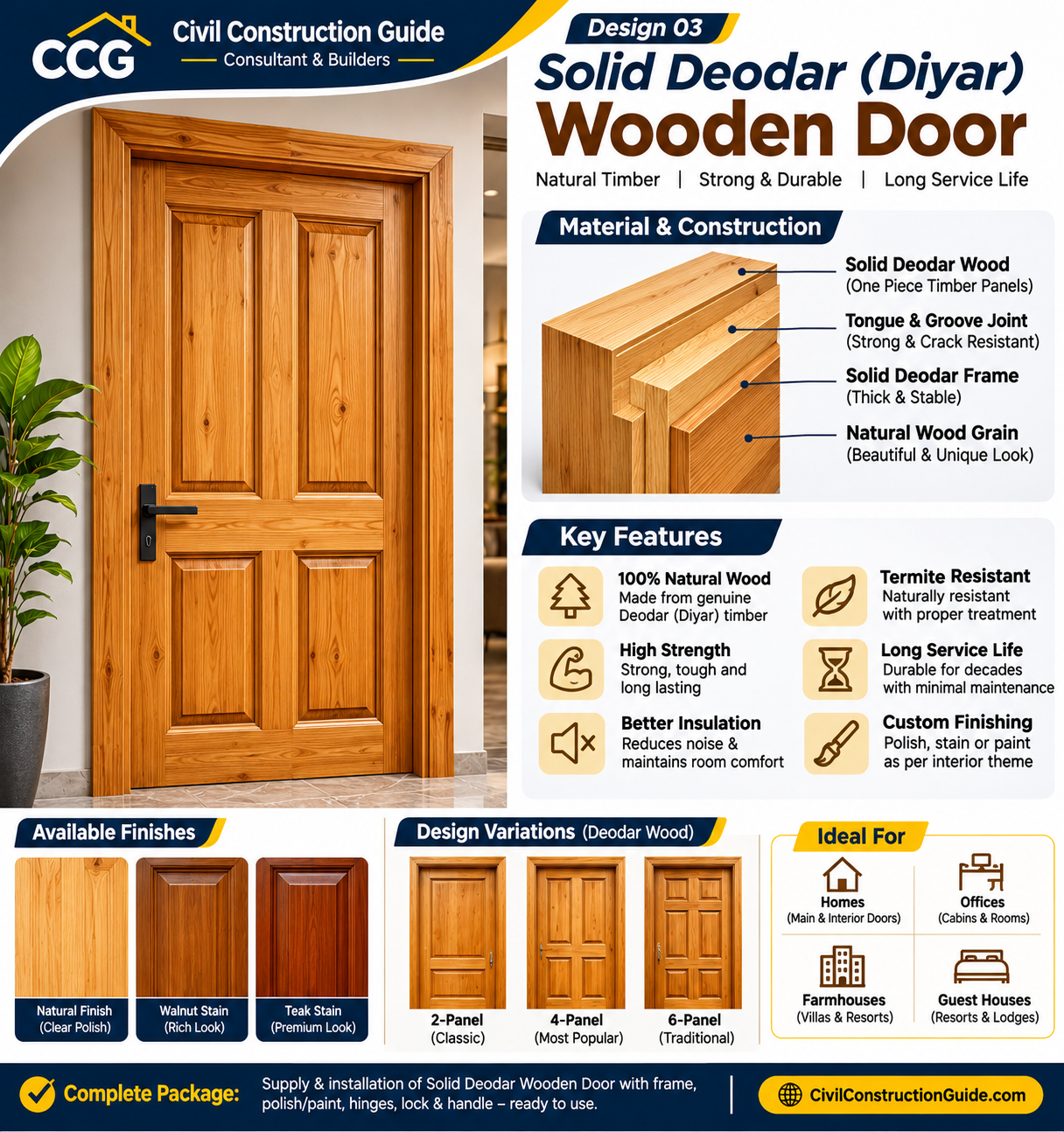
3. Solid Deodar (Diyar) Wooden Door
Construction: Cedrus deodara softwood; specify seasoned timber, grade, joinery and protective coating. Natural resistance is not termite-proofing.
Recommended application: Protected interior and traditional applications.
4. Solid Ash Wooden Door
Construction: Fraxinus hardwood with prominent grain. Use seasoned stiles and rails with floating panels to accommodate movement.
Recommended application: Premium interior joinery.

5. Solid Oak Wooden Door
Construction: Quercus hardwood; confirm actual species and grade. Properly accommodate timber movement and heavier door weight.
Recommended application: Premium interior and suitably protected entrance applications.

6. Solid Mahogany Wooden Door
Construction: Swietenia and Khaya are distinct timber groups; verify actual species. A mahogany-coloured stain does not prove species.
Recommended application: Decorative interior doors.
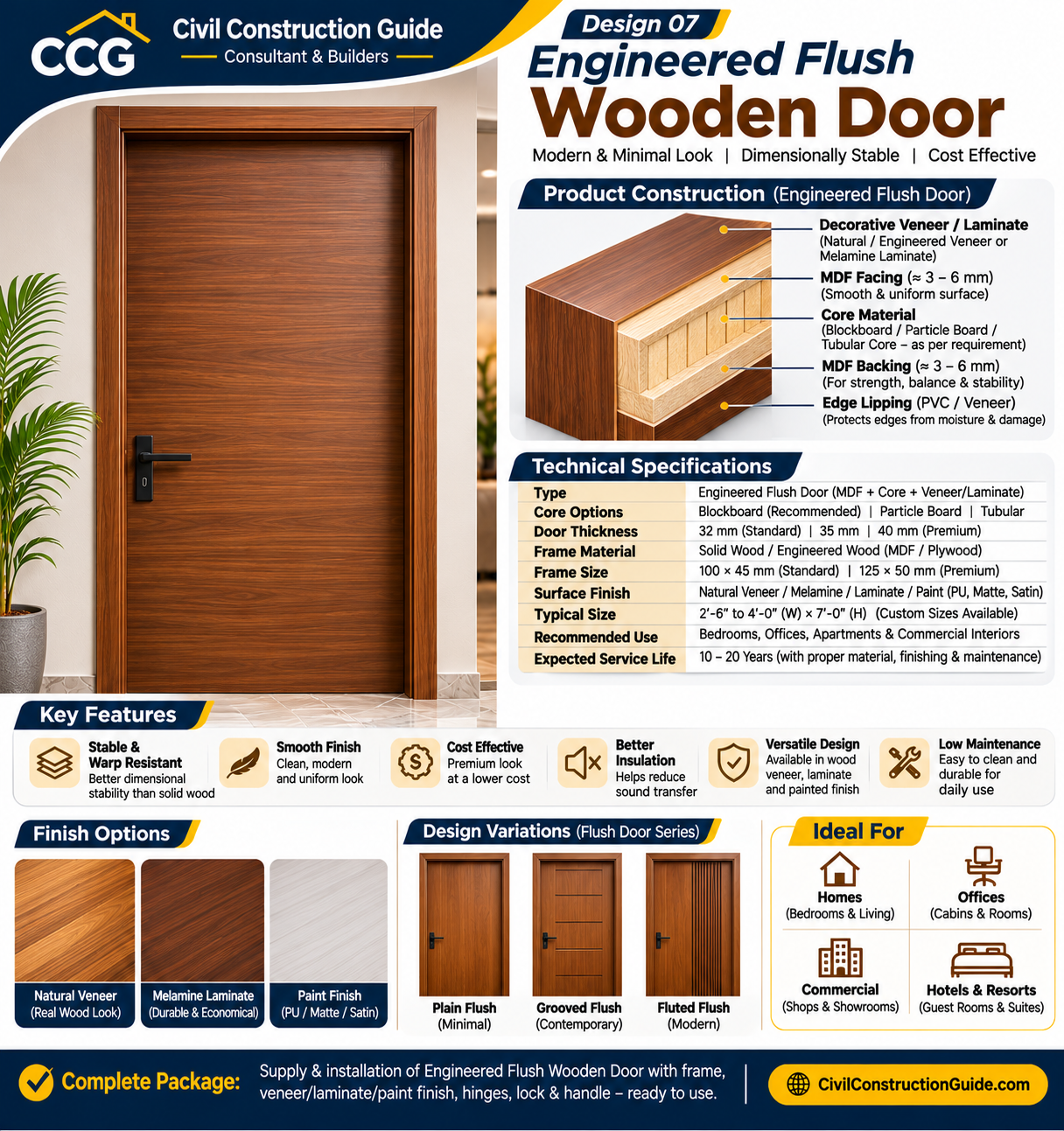
7. Engineered Flush Wooden Door
Construction: Flat-faced leaf with specified core (hollow, cellular, particleboard or blockboard), facings and lock blocks.
Recommended application: Modern interior rooms and offices.
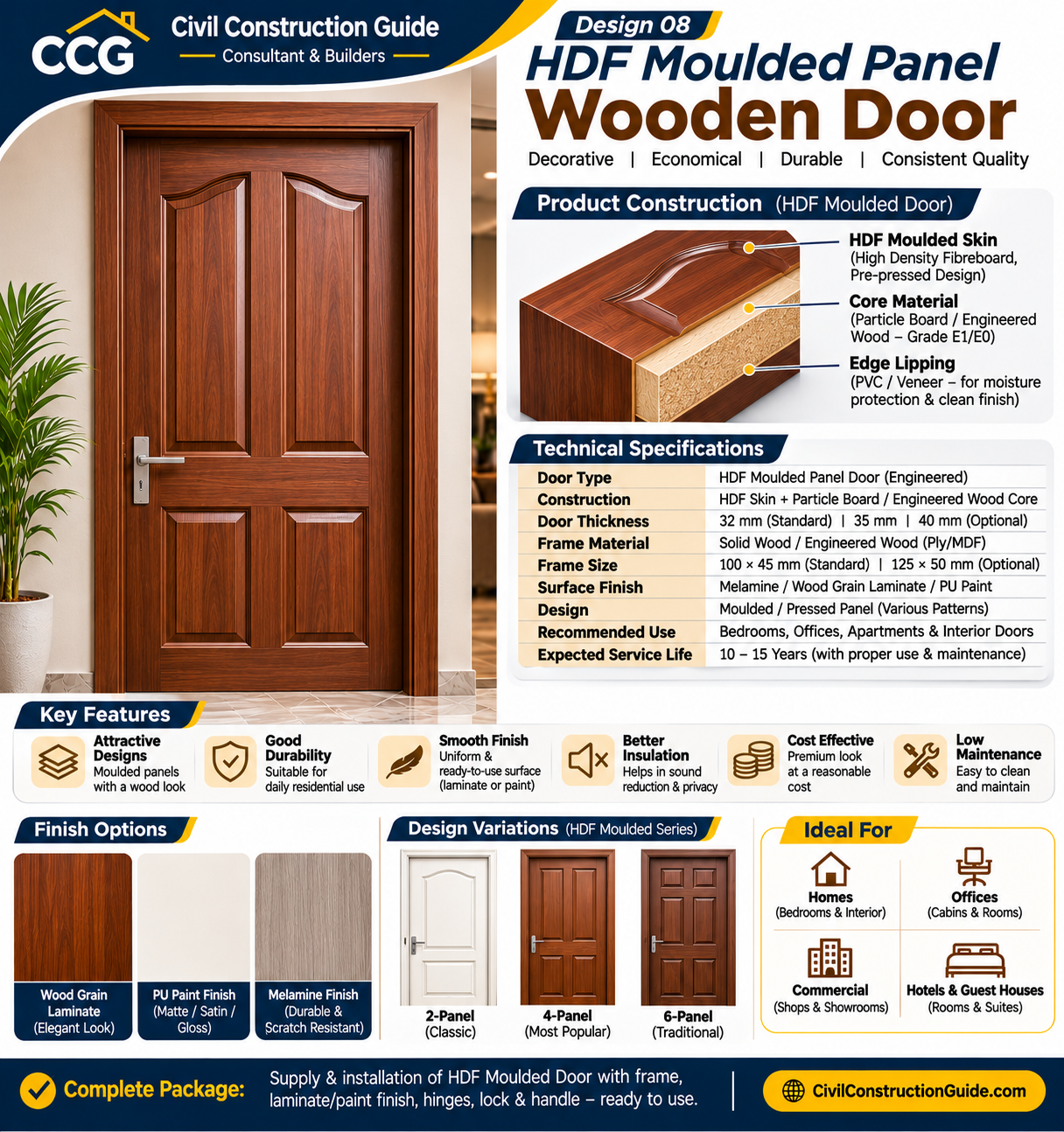
8. HDF Moulded Wooden Door
Construction: Pressed fibreboard skins bonded over a framed core. Confirm skin, core and manufacturer moisture limitations.
Recommended application: Dry interior bedrooms.
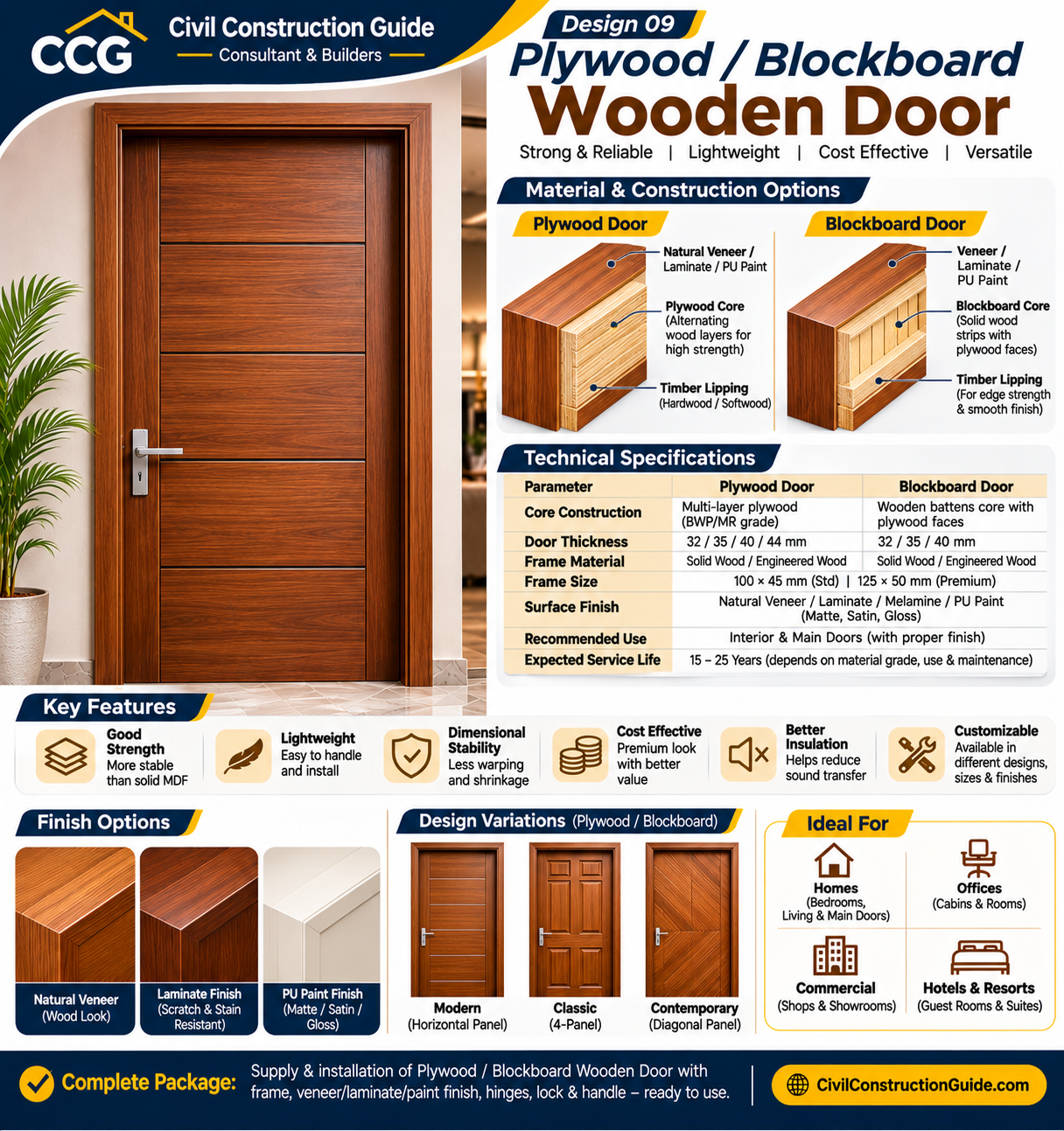
9. Plywood / Blockboard Wooden Door
Construction: Plywood uses bonded cross-grain veneers; blockboard uses timber-strip core and bonded faces. Specify grade and edge treatment.
Recommended application: Interior doors using appropriately rated panels.

10. Teak Veneer Wooden Door
Construction: Real teak veneer bonded to engineered substrate; not a solid teak door. Confirm veneer species, adhesive and core.
Recommended application: Decorative contemporary interiors.
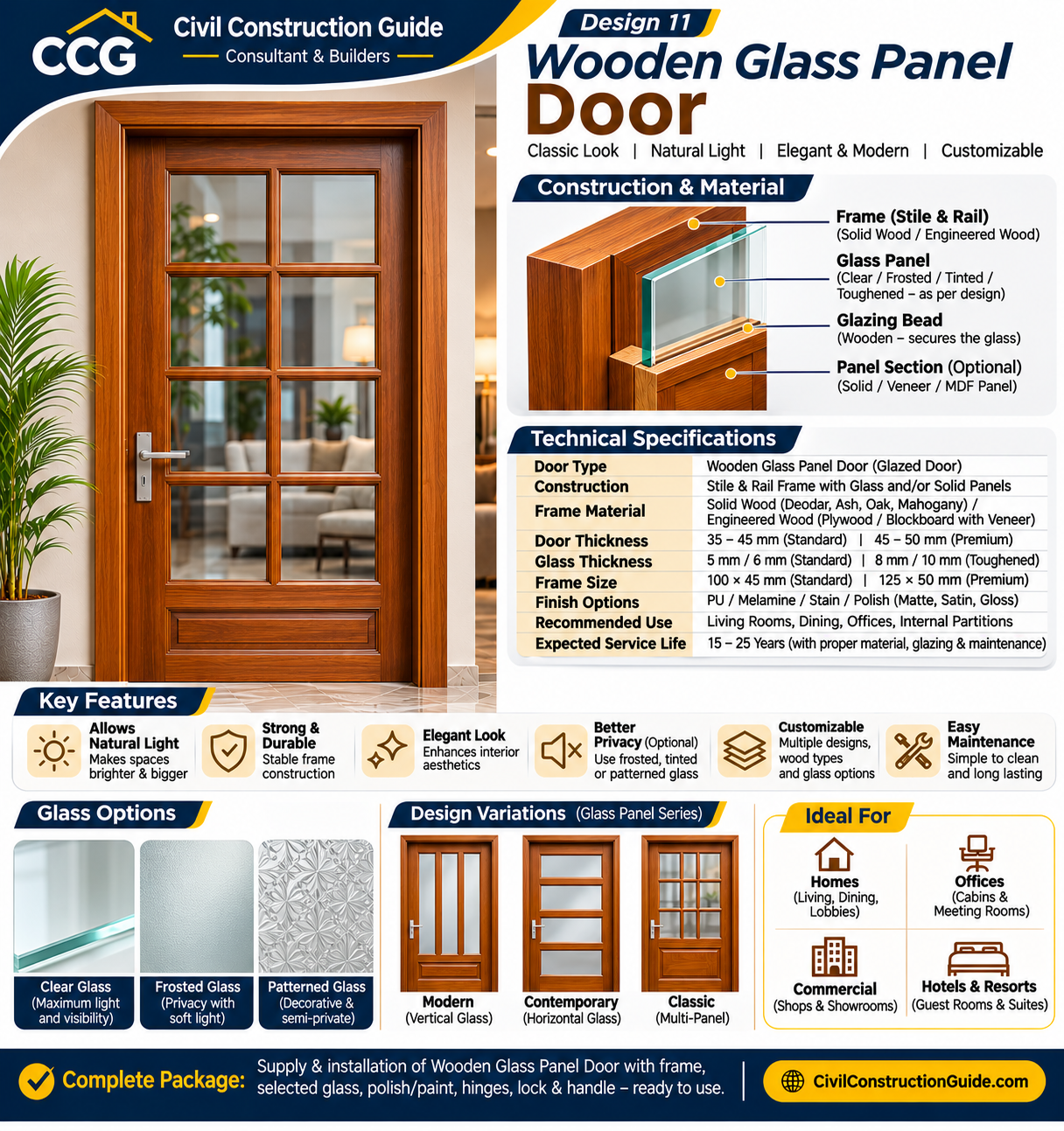
11. Wooden Glass Panel Door
Construction: Timber or engineered frame with glazing. Specify safety glass based on size, location and impact risk.
Recommended application: Living rooms, offices and daylight connections.

12. CNC Grooved Wooden Door
Construction: Decorative CNC grooves cut into compatible substrates; confirm depth, remaining facing thickness and sealing.
Recommended application: Modern feature doors and interior rooms.
Comparison: solid timber vs engineered doors
Solid timber offers natural wood throughout the specified components and can often be refinished, but its dimensions change with moisture. Engineered doors can provide consistent finishes and economical options, yet their performance depends on the exact core, adhesive, facings and edge protection. Neither category is automatically waterproof, termite-proof or soundproof.
Sizes, frames and hardware
Nominal 35, 40 and 45 mm leaf thicknesses are common selectable options, not universal standards. Check leaf size separately from the clear opening and masonry opening. Select hinges by actual leaf mass; verify frame anchorage, lock reinforcement, clearances and operation.
Finishing and moisture protection
Clear coatings display natural grain; stains modify colour; compatible polyurethane and paint systems protect prepared surfaces; laminates provide manufactured patterns. Seal exposed edges and follow manufacturer instructions. Standard HDF and MDF products should not be assumed suitable for wet bathrooms or exterior exposure.
Wooden Door Prices in Pakistan: What Affects the Cost?
Request dated local quotations rather than relying on a fixed online rate. Compare identical specifications: timber species, grade, leaf thickness, core, facing, frame, architraves, finish, lockset, hinges, transport and installation. Installed cost = leaf + frame + architraves + hardware + finish + transport + labour.
Pre-purchase inspection checklist
- Verify wood species and actual core by supplier documentation or sample.
- Confirm timber seasoning and moisture suitability.
- Check leaf dimensions, squareness, joinery and edge sealing.
- Check hardware capacity, fixing and smooth latching.
- For glass doors, confirm appropriate safety glazing and secure beads.
- Confirm whether quotation includes complete installation.
Frequently asked questions
Are teak veneer doors solid teak?
No. Teak veneer is a thin decorative timber layer bonded to a substrate.
Are HDF doors waterproof?
Not by default. Check manufacturer testing and intended exposure.
Are CNC grooves structurally stronger?
No. CNC is a machining process for decorative patterns; strength depends on the underlying construction.
What is the best door for a bedroom?
A well-made solid or engineered interior door can work; choose by privacy, budget, core quality, finish and installation.
Further reading
UPVC door designs in Pakistan and Ceramic tile materials guide.
About the author
Engr. Muhammad Bilal writes practical construction and building-material guidance for Civil Construction Guide. The design images are conceptual illustrations and do not certify any manufacturer’s internal construction or service life.

Muhammad Bilal is a Civil Engineer and Construction Specialist with an MS in Engineering Management and 13+ years of professional experience. He shares practical construction knowledge, cost estimation, and RCC site expertise at CivilConstructionGuide.com.