
Building a house in Pakistan is a major investment, but smart cost control does not mean cutting corners on safety. The greatest opportunities usually come from efficient planning, accurate quantities, sensible purchasing and avoiding rework. This practical guide explains 15 ways to reduce construction costs while protecting structural performance and long-term durability.
Updated November 2026. The numerical examples below are illustrative scenarios, not verified local market rates.
Why do house construction budgets increase?
Common causes include incomplete drawings, unnecessary covered area, design changes after work begins, poorly defined contractor scope, material waste, delayed deliveries and uncontrolled finishing upgrades. Establish a realistic contingency and review costs at every construction stage.
15 smart ways to reduce house construction costs
1. Prepare complete drawings before starting
Coordinate architectural, structural, electrical and plumbing drawings before excavation. Finalize room dimensions, staircase, window locations, plumbing shafts and electrical points. Late changes can require demolition and rework. Obtain local approvals where required.
2. Eliminate unnecessary covered area
Review circulation, oversized corridors and rooms that will rarely be used. A functional, compact layout can save on foundations, roofing, walls and finishes. For example, removing 150 sq ft at an assumed marginal cost of PKR 5,000/sq ft avoids PKR 750,000 in scope; this is an illustration, not a current market quotation.
3. Prefer a regular, simple building form
Straightforward plans and restrained elevations often reduce complex formwork, wall junctions, waterproofing details and decorative labour. Compare designs on equivalent usable area and performance rather than appearance alone.
4. Commission a project-specific structural design
A qualified engineer can evaluate the appropriate foundation system, framing, spans and reinforcement for the actual soil, loading and code requirements. Never arbitrarily reduce steel, member sizes, concrete strength or foundation depth to save money.

5. Prepare a detailed BOQ
Measure excavation, concrete, reinforcement, masonry, plaster, flooring, plumbing and electrical work from coordinated drawings. Specify quality, units, allowances and wastage so competing contractors price the same scope.
6. Compare delivered material prices
Request comparable written quotations for cement, steel, brick, sand and aggregate. Include grade, brand, transport, unloading, taxes, testing and delivery schedule. The cheapest unit quote may not be the lowest delivered price.

7. Control material wastage
Store cement dry and off the ground, protect steel and finishing products, track delivery quantities and prepare a bar-bending schedule. Mix only needed mortar and protect fresh concrete; never save money by reducing specified curing.
8. Choose fit-for-purpose materials
Compare locally available, code-compliant materials on strength, durability, maintenance, thermal performance and total installed cost. Structural substitutions need design approval. Reserve premium finishes for areas where they add genuine value.
9. Freeze the design and manage variations
Agree room layouts, kitchens, bathrooms and finishing schedules before work begins. Record each proposed change with its additional cost and schedule effect before authorizing it.
10. Select the contractor on total value
Check references, completed work, supervision and written scope. Compare labour-only and turnkey offers on equivalent inclusions. Define milestones, material specifications, inspections, variations and payment certification in the contract.
11. Sequence work to prevent idle labour
Plan procurement and crews around excavation, foundations, framing, masonry, MEP rough-in, plaster, waterproofing and finishes. Avoid repeated mobilization and unnecessary trade overlap.
12. Use practical finishing specifications
Choose durable, appropriately priced flooring, doors, windows, paint and cabinetry. Standard sizes and simple ceiling details can reduce offcuts and custom fabrication, but moisture resistance and workmanship still matter.
13. Coordinate electrical and plumbing early
Confirm supply, drainage, ventilation, lighting and socket layouts before walls are closed. Use correctly rated cables, protective devices and pipes; test installations before covering them.
14. Consider phased construction carefully
Deferring non-essential decoration may help cash flow. Design for any future storey from the outset and protect exposed work. Repeated mobilization and inflation can make phasing more expensive overall.
15. Use qualified site supervision
Inspect reinforcement before concrete placement, verify quantities, monitor curing and waterproofing, and certify contractor measurements. Independent oversight can prevent costly defects and rework.
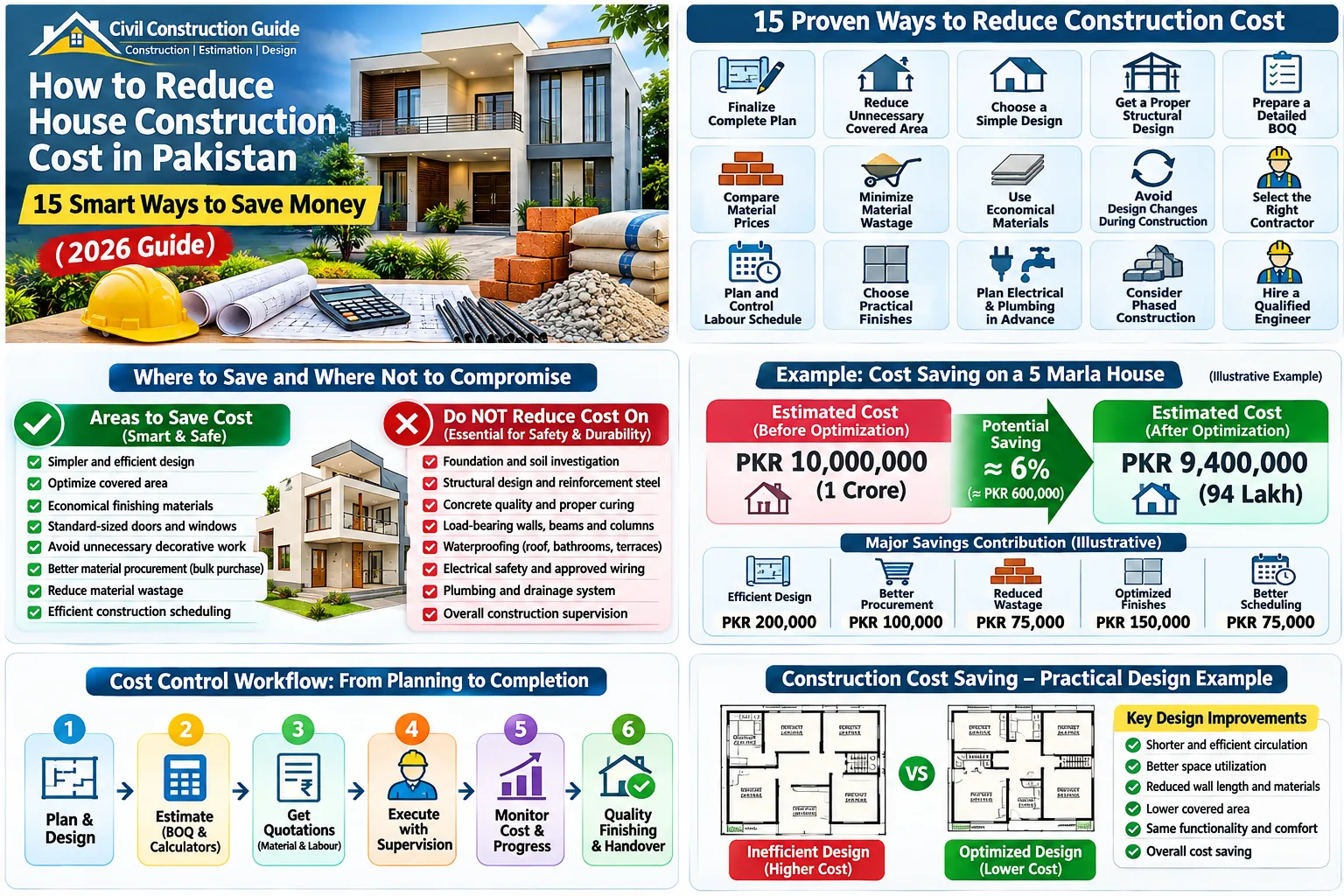
Illustrative 5 Marla cost-saving example
Suppose a hypothetical 5 Marla project has a baseline budget of PKR 10,000,000. The following possible savings are assumptions for teaching cost control, not promised results or verified November 2026 quotations.
| Measure | Illustrative saving (PKR) |
|---|---|
| Efficient design and scope | 200,000 |
| Procurement | 100,000 |
| Reduced waste | 75,000 |
| Practical finishes | 150,000 |
| Scheduling and reduced rework | 75,000 |
| Total | 600,000 |
In this scenario, PKR 600,000 / PKR 10,000,000 = 6%, leaving an illustrative budget of PKR 9,400,000. Real savings depend on approved drawings, location, site conditions and specifications; categories can overlap, so avoid double-counting.
Worked example: calculate material waste before ordering
Assume an approved tile layout needs 1,000 sq ft of finished floor tiles. With a planning allowance of 7% for cuts and breakage, the initial purchase quantity is 1,000 × 1.07 = 1,070 sq ft. If a revised layout reduces the allowance to 4%, the quantity becomes 1,040 sq ft: a difference of 30 sq ft. At an illustrative tile supply price of PKR 250 per sq ft, that represents PKR 7,500 in avoided tile purchases. The allowances and rate are hypothetical; actual waste depends on tile size, pattern, room geometry, workmanship and packaging quantities. Do not under-order: confirm the layout and supplier pack sizes first.
Sample BOQ structure for a Pakistani house
A reliable BOQ separates quantity, unit, specification, unit rate and total amount. For example, concrete is measured by volume, reinforcement by weight, and tiles by area. An illustrative concrete item might be 100 cubic feet at an assumed installed rate of PKR 600 per cubic foot, giving PKR 60,000. This is a calculation example, not a verified market rate or a structural mix recommendation. A proper estimate must also distinguish excavation, disposal, shuttering, steel fixing, electrical conduits, taxes and transport so no item is counted twice.
Labour-only versus turnkey: compare like with like
| Factor | Labour-only contract | Turnkey contract |
|---|---|---|
| Material purchases | Usually arranged by owner | Usually arranged by contractor |
| Price certainty | Owner exposed to material-price changes | Depends on contract inclusions and variation clauses |
| Time commitment | Higher procurement and coordination effort | Lower day-to-day purchasing effort |
| Cost control | Direct visibility into invoices | Requires detailed specifications and milestone verification |
Ask both bidders to price the same drawings, material brands or grades, labour scope, testing, wastage, overheads and completion requirements. A lower quoted labour rate does not automatically mean a lower final cost.
Plan a contingency instead of spending the full budget
Set aside a project-specific contingency for unforeseen ground conditions, approved variations and price movements. For illustration, a 5% allowance on a PKR 10 million baseline is PKR 500,000; this is a budgeting example, not a universally sufficient contingency. Record committed costs, paid amounts and the remaining forecast each week. Do not treat contingency as permission to omit necessary soil testing, inspections or waterproofing.
Before you sign a construction contract: quick checklist
- Approved coordinated architectural and structural drawings
- Itemized BOQ with measurement rules and material specifications
- Written payment milestones tied to inspected progress
- Clear treatment of variations, delays, taxes and price escalation
- Quality testing, curing, waterproofing and safety responsibilities
- Documented snagging, handover and defect-correction process
Editorial note: This guide explains cost-control principles, not live November 2026 material prices. For accurate budgeting, use current supplier quotations and a project-specific engineer-reviewed estimate.
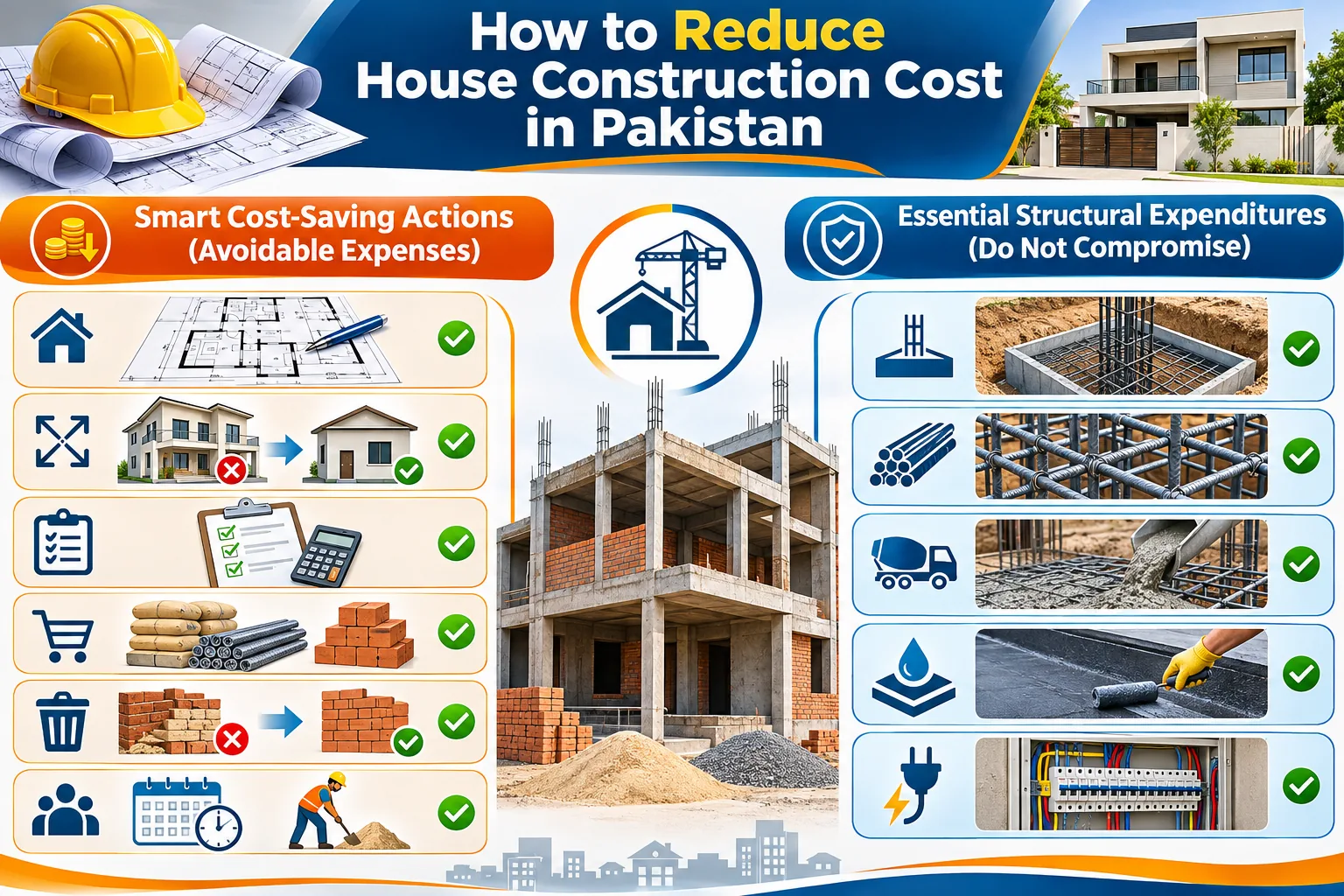
Where you should never cut costs
Do not compromise geotechnical investigation where needed, foundations, structural reinforcement and detailing, concrete strength and curing, safe electrical protection, reliable plumbing, waterproofing or required inspections. A qualified engineer must approve structural design changes.
Useful construction cost calculators
Estimate your scope with our Foundation Cost Calculator and compare project types with our 3 Marla construction cost guide and 7 Marla construction cost guide. Calculator outputs are preliminary estimates, not substitutes for a project-specific BOQ.
Frequently asked questions
What is the best way to reduce house construction cost?
Start with coordinated drawings, a right-sized layout and a detailed BOQ; compare equivalent contractor quotations and control changes.
Can I save money without compromising quality?
Yes. Reduce unnecessary area, avoid rework and select durable value-for-money finishes while preserving structural and safety requirements.
Is labour-only contracting always cheaper?
No. It shifts procurement, storage and supervision responsibilities to the owner. Compare the complete delivered project cost.
Should I reduce reinforcement steel to save money?
No. Reinforcement must follow an approved structural design. Only a qualified engineer should assess design optimization.
Can a 5 Marla house be built in phases?
Yes, with appropriate structural design, approvals, weatherproofing and services, although phasing may increase overall cost.
How much can planning save?
There is no guaranteed percentage. The 6% example above is hypothetical; actual savings require project-specific estimates.
Final advice
The lowest upfront price is not always the lowest lifetime cost. Spend on accurate design, safe construction and proper inspection; save through efficient layouts, procurement and project management.
Need a BOQ or construction planning support? Explore the engineering resources at Civil Construction Guide and our YouTube channel Practical Civil Engineers (@civilengineers99). Contact us through the website for project-specific enquiries.
Disclaimer: Educational information only. Rates, savings and quantities are project-dependent; obtain approved drawings and professional review before construction.

Muhammad Bilal is a Civil Engineer and Construction Specialist with an MS in Engineering Management and 13+ years of professional experience. He shares practical construction knowledge, cost estimation, and RCC site expertise at CivilConstructionGuide.com.