
Plain Cement Concrete (PCC) is one of the most important components used in building construction. PCC provides a strong, level, and stable base before RCC work starts.
To simplify construction estimation work, this advanced PCC Concrete Calculator helps calculate the PCC rate per sq ft with material along with the quantities and costs required for plain cement concrete work in Pakistan:
✔ Cement quantity (bags)
✔ Sand quantity (CFT)
✔ Crush/Aggregate quantity (CFT)
✔ Wet & dry volume
✔ Labour cost
✔ Contractor profit
✔ Grand total PCC cost
✔ Cost per square foot
Discover More
Property Tax Calculator Unit Converter Quantity Takeoff Sheets Construction Cost Calculator Building Materials House Plans Videos Concrete Calculator Column Steel CalculatorUse Online PCC Calculator
👉 Civil Construction Guide PCC Work Cost Calculator
PCC Concrete Calculator
Civil Construction Guide — By Engr. Muhammad Bilal
| Description | Value |
|---|---|
| Total Area | |
| Wet Volume | |
| Dry Volume | |
| Cement Quantity | |
| Sand Quantity | |
| Crush Quantity | |
| Material Cost | |
| Labour Cost | |
| Total Cost | |
| Contractor Profit (15%) | |
| Grand Total | |
| Cost Per Sq.ft |
Formula Used
Wet Volume = Length × Width × Thickness ÷ 12
Dry Volume = Wet Volume × 1.54
Material quantities are calculated according to selected PCC ratio.
Labour Productivity = 1 Mason + 2 Labour can complete approximately 100 CFT PCC work per day.
This calculator is specially useful for:
- Civil engineers
- Contractors
- Quantity surveyors
- Students
- House owners
What is PCC in Construction?
PCC stands for Plain Cement Concrete. It is a mixture of:
- Cement
- Sand
- Crush aggregate
- Water
PCC is placed below foundations, flooring, and RCC members to create a smooth and durable base.
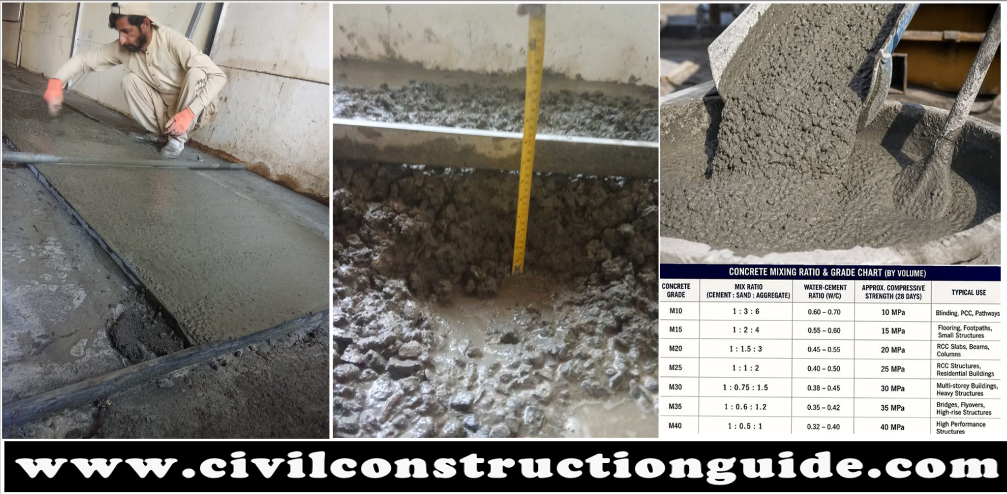
Purpose of PCC Work
PCC provides:
✔ Level surface for foundations
✔ Load distribution
✔ Protection of reinforcement from soil
✔ Prevention of direct RCC-soil contact
✔ Improved structural stability
Common PCC Ratios Used in Construction
Different PCC ratios are used according to structural requirements.
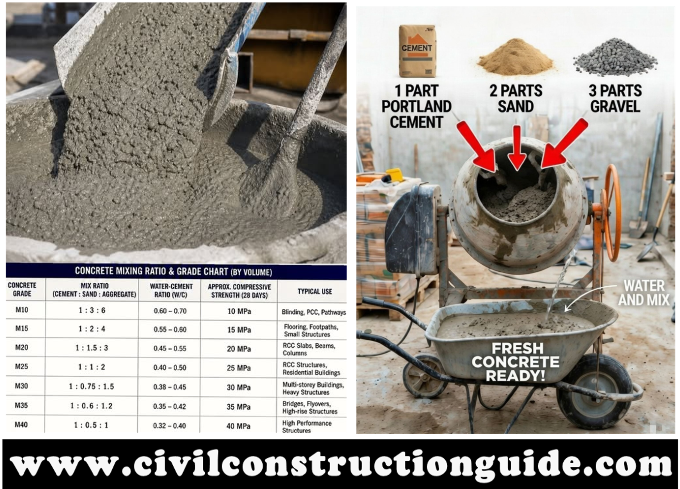
PCC Ratio 1:4:8
This is lean concrete.
Used For:
- Foundation base
- Levelling course
- Non-structural filling
Advantages:
✔ Economical
✔ Low cement consumption
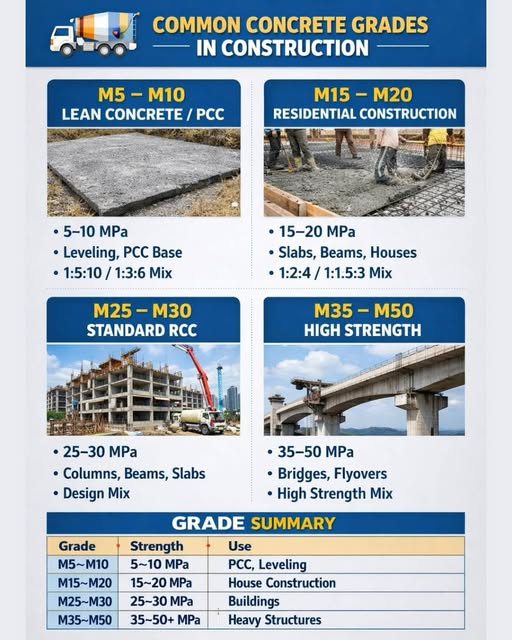
PCC Ratio 1:3:6
This ratio provides medium strength.
Used For:
- Residential foundations
- Sidewalks
- Flooring base
Advantages:
✔ Better durability
✔ Good load distribution
PCC Ratio 1:2:4
This is a stronger PCC mix.
Used For:
- Floor slabs
- Water tanks
- Structural concrete works
Advantages:
✔ High strength
✔ Better bonding
PCC Ratio 1:1.5:3
This is high-strength concrete.
Used For:
- Heavy structural works
- Industrial flooring
- High load areas
Advantages:
✔ Excellent compressive strength
✔ Long durability
Discover More
RCC Slab Cost Calculator Block Masonry Calculator Tiles & Marble Calculator Property Tax Calculator 5 Marla Frame Structure Cost & Calculator 5 Marla Grey Structure Cost Guide 5 Marla Foundation Cost Guide Wooden vs Fiber Doors Cost 2025 Basic Components of a Building Guide How to Calculate Steel Quantity in BeamPCC Concrete Formula
1. Area Formula
Area=Length×WidthArea = Length \times WidthArea=Length×Width
2. Wet Volume Formula
Wet Volume=Length×Width×Thickness12Wet\ Volume = Length \times Width \times \frac{Thickness}{12}Wet Volume=Length×Width×12Thickness
3. Dry Volume Formula
Dry Volume=Wet Volume×1.54Dry\ Volume = Wet\ Volume \times 1.54Dry Volume=Wet Volume×1.54
Dry volume factor accounts for:
- Wastage
- Bulking of sand
- Voids in aggregate
Cement Quantity Formula
For PCC ratio 1:2:4:
Cement=Dry Volume×11+2+4Cement = \frac{Dry\ Volume \times 1}{1+2+4}Cement=1+2+4Dry Volume×1
Sand Quantity Formula
Sand=Dry Volume×21+2+4Sand = \frac{Dry\ Volume \times 2}{1+2+4}Sand=1+2+4Dry Volume×2
Crush Aggregate Formula
Aggregate=Dry Volume×41+2+4Aggregate = \frac{Dry\ Volume \times 4}{1+2+4}Aggregate=1+2+4Dry Volume×4
Labour Calculation in PCC Work
On actual construction sites, PCC work is generally executed by:
- 1 Mason
- 2 Labour helpers
PCC Labour Productivity
A standard PCC gang can complete approximately:
✔ 100 CFT PCC work per day
Labour Rates Used in Calculator
Current Market Rates:
- Mason = Rs 2000/day
- Labour = Rs 1200/day each
Total Daily Gang Cost:
2000 + (1200 × 2) = Rs 4400/dayThe calculator automatically converts this into labour cost per CFT for accurate estimation.
Importance of PCC Curing
Curing is essential after concrete placement.
Recommended PCC Curing Time
✔ Minimum 7 days curing required
Benefits of Proper Curing
✔ Increases concrete strength
✔ Reduces shrinkage cracks
✔ Improves durability
✔ Enhances surface quality
Common Mistakes During PCC Work
Avoid these common site mistakes:
❌ Excess water in concrete
❌ Wrong mix ratio
❌ Poor compaction
❌ Improper curing
❌ Uneven thickness
❌ Low-quality aggregate
These mistakes can reduce concrete strength and durability.
Standard PCC Thickness
| Construction Item | Standard Thickness |
|---|---|
| Foundation PCC | 3″ to 6″ |
| Flooring PCC | 4″ |
| Road PCC | 6″ to 8″ |
| Levelling PCC | 2″ to 3″ |
What This PCC Calculator Provides
This calculator automatically calculates:
✔ Total area
✔ Wet volume
✔ Dry volume
✔ Cement quantity (bags)
✔ Sand quantity (CFT)
✔ Crush quantity (CFT)
✔ Labour cost
✔ Material cost
✔ Contractor profit (15%)
✔ Grand total PCC cost
✔ Cost per square foot
Advantages of Using PCC Calculator
✔ Fast calculation
✔ Reduces manual estimation errors
✔ Useful for BOQ preparation
✔ Accurate construction budgeting
✔ Helpful for contractors and engineers
Related Construction Calculators
You may also check:
- Plaster Work Unit Cost Calculator
- Civil Construction Guide Home Page
- 10 Marla House Construction Cost in Pakistan 2025
- 10 Marla Slab Cost May 2026 in Pakistan | Complete RCC Lanter Cost with Material Breakdown
- RCC Slab Calculator
Frequently Asked Questions (FAQ)
What is PCC in civil engineering?
PCC means Plain Cement Concrete used as a base layer below RCC and foundations.
Which PCC ratio is best for foundations?
1:4:8 and 1:3:6 are commonly used for foundation PCC.
Why is dry volume multiplied by 1.54?
It accounts for:
- Wastage
- Bulking
- Aggregate voids
What is the curing time for PCC?
Minimum recommended curing time is 7 days.
Final Words
PCC estimation is an important part of construction planning. Proper understanding of concrete ratios, curing methods, labour productivity, and material quantities helps improve project quality and cost control.
This PCC Concrete Calculator is designed to provide practical and real-world construction estimation for engineers, contractors, students, and house owners.

Muhammad Bilal is a Civil Engineer and Construction Specialist with an MS in Engineering Management and 13+ years of professional experience. He shares practical construction knowledge, cost estimation, and RCC site expertise at CivilConstructionGuide.com.