
Foundation is one of the most important structural components of any building. A properly designed footing safely transfers building loads to the soil and ensures structural stability.
Discover More
RCC Slab Cost Calculator Block Masonry Calculator Tiles & Marble Calculator Property Tax Calculator 5 Marla Frame Structure Cost & Calculator 5 Marla Grey Structure Cost Guide 5 Marla Foundation Cost Guide Wooden vs Fiber Doors Cost 2025 Basic Components of a Building Guide How to Calculate Steel Quantity in BeamIf footing size is insufficient, the structure may experience settlement, cracks, or even structural failure.
In this detailed civil engineering guide, we will explain how to calculate footing size using structural load and soil bearing capacity with a simple step-by-step method.
This article is highly useful for civil engineers, students, contractors, and homeowners involved in building construction.

What is Footing?
A footing is the lowest part of the foundation that distributes the load of columns and walls safely to the soil.
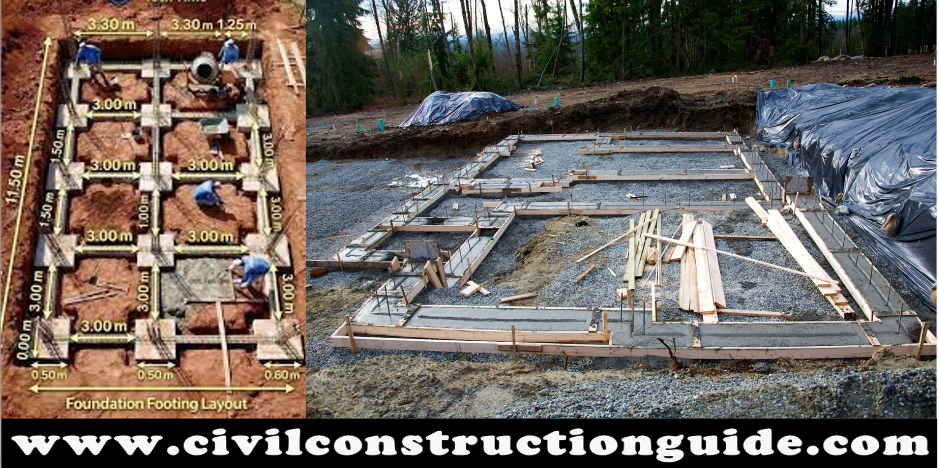
The main purpose of footing is:
✔ Load distribution
✔ Structural stability
✔ Settlement control
✔ Safe transfer of building loads
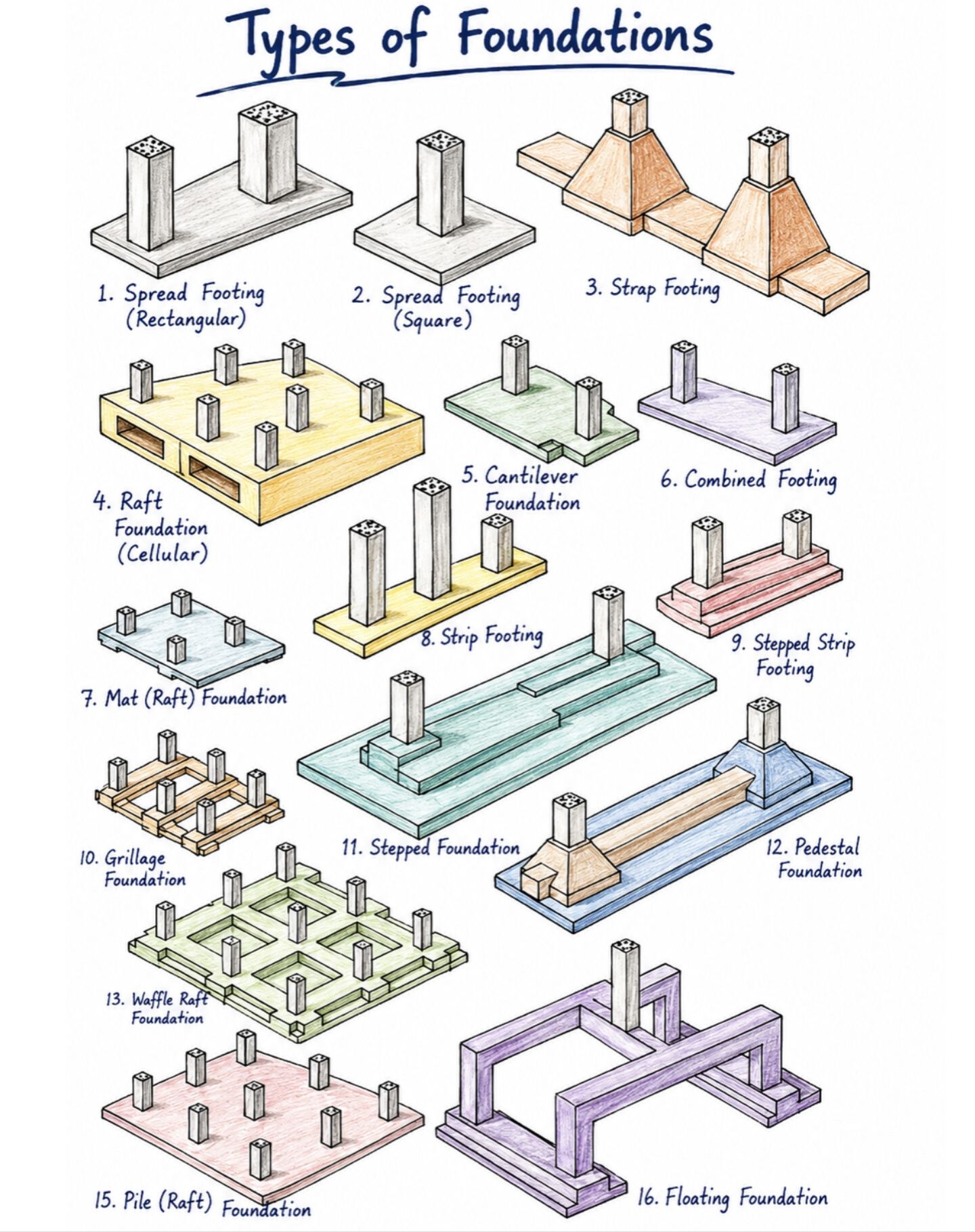
Types of Footings Used in Building Construction
Different footing types are used depending on structural load and soil conditions.
Common Types of Footings
- Isolated Footing
- Combined Footing
- Strap Footing
- Raft Foundation
- Pile Foundation
In residential construction, isolated footing is most commonly used.
Important Terms Before Footing Design
Before calculating footing size, you must understand two important terms.
1️⃣ Structural Load
Structural load is the total load coming from:
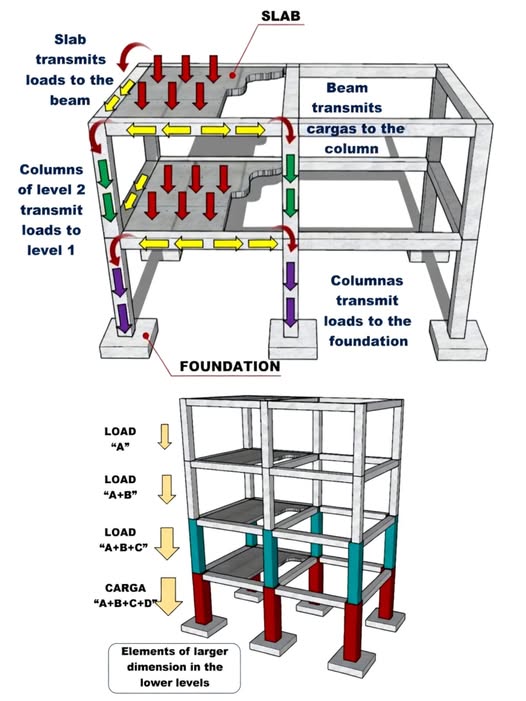
- Slab
- Beams
- Columns
- Walls
- Live loads
Example:
Total Structural Load = 5000 kN
2️⃣ Soil Bearing Capacity (SBC)
Soil bearing capacity is the maximum load soil can safely carry without failure.
Example:
Bearing Capacity of Soil = 18,000 kg/m²
Different soils have different SBC values.
| Soil Type | Approximate SBC |
|---|---|
| Soft Soil | 5,000–10,000 kg/m² |
| Medium Soil | 10,000–20,000 kg/m² |
| Hard Soil | 20,000–45,000 kg/m² |
Step-by-Step Footing Size Calculation
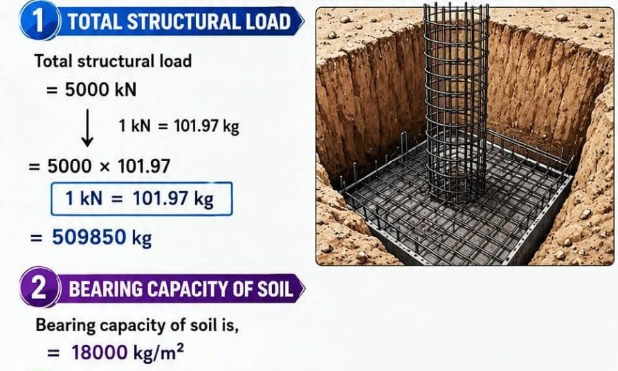
Now let’s calculate footing size using the example shown in the image.
Step 1: Calculate Total Structural Load
Given:
Total Load
= 5000 kN
We know:
1 kN = 101.97 kg
Therefore:
Total Load in kg
= 5000 × 101.97
= 509,850 kg
Step 2: Soil Bearing Capacity
Given:
SBC
= 18,000 kg/m²
Step 3: Calculate Total Footing Area Required
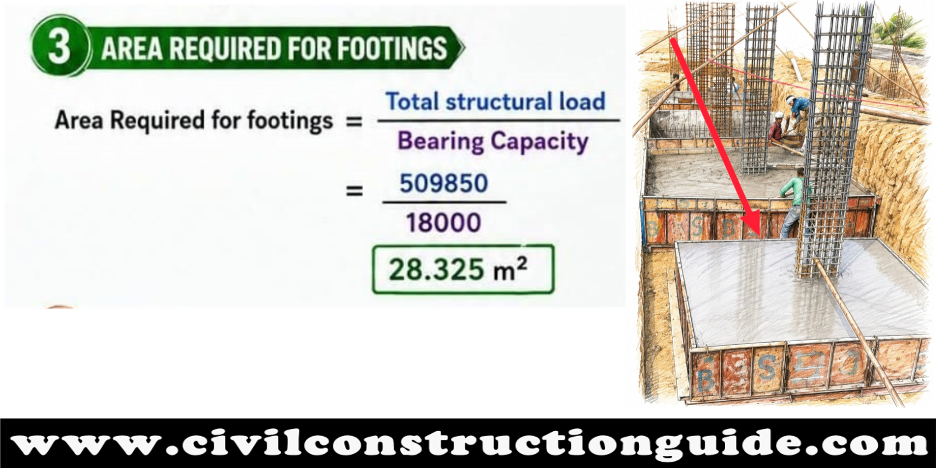
Formula
Area Required for Footing = Total Structural Load / Soil Bearing Capacity
Substituting values:
= 509,850 / 18,000
= 28.325 m²
So,
Total Required Footing Area
= 28.325 m²
Step 4: Calculate Area of One Footing
Suppose the building has:
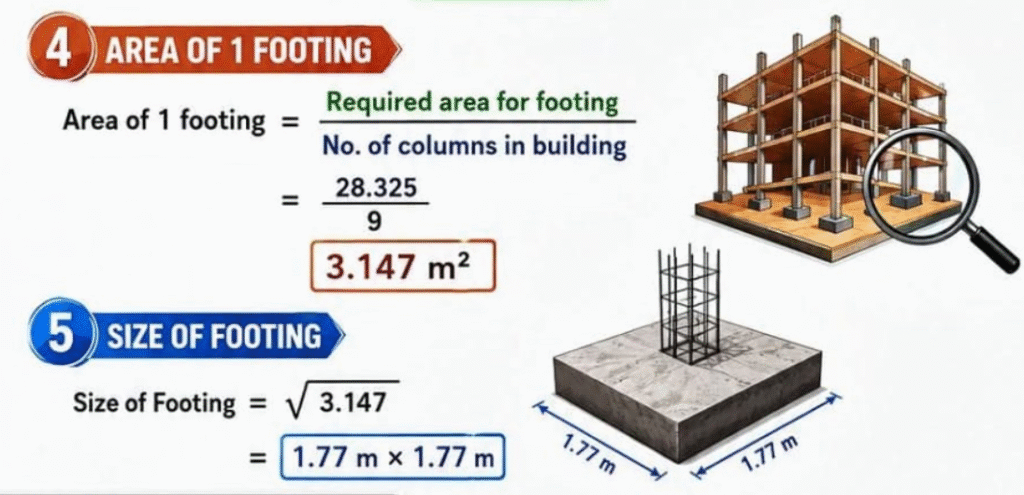
Number of Columns
= 9
Formula
Area of One Footing = Total Required Area / Number of Columns
= 28.325 / 9
= 3.147 m²
Step 5: Calculate Footing Dimensions
For square footing:
Formula
Footing Size = √Area
= √3.147
= 1.77 m
Therefore,
Final Footing Size
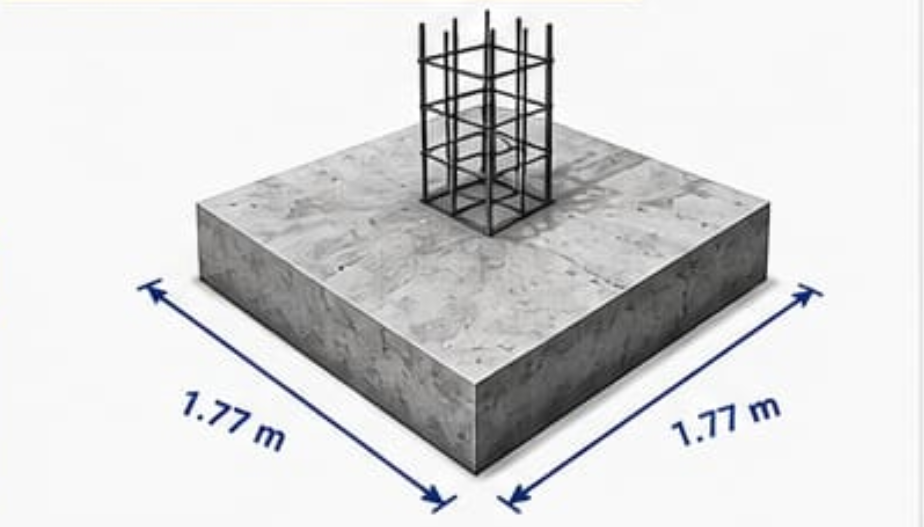
✅ 1.77 m × 1.77 m
Summary Table of Calculation
| Step | Formula | Result |
|---|---|---|
| Total Structural Load | 5000 × 101.97 | 509,850 kg |
| Total Footing Area | 509,850 / 18,000 | 28.325 m² |
| Area of One Footing | 28.325 / 9 | 3.147 m² |
| Footing Size | √3.147 | 1.77 m × 1.77 m |
Why Soil Bearing Capacity is Important
Soil bearing capacity directly affects footing size.
Low SBC Soil
Requires larger footing size.
High SBC Soil
Allows smaller footing size.
Therefore, soil testing is extremely important before foundation design.
Important Engineering Considerations
Footing size should never be selected only on approximate calculations.
Professional design also considers:
✔ Dead load
✔ Live load
✔ Wind load
✔ Earthquake load
✔ Reinforcement design
✔ Settlement analysis
Common Mistakes in Footing Design
Avoid these construction mistakes:
❌ Ignoring soil testing
❌ Using undersized footing
❌ Poor concrete quality
❌ Improper reinforcement
❌ No curing
❌ Uneven excavation
Practical Tips for House Construction
✔ Always conduct soil investigation
✔ Use proper concrete mix ratio
✔ Follow structural drawings
✔ Ensure proper curing
✔ Hire qualified civil engineers
Watch Detailed Video Explanation
Watch the practical explanation of footing size calculation in the video below.
Frequently Asked Questions (FAQ)
What is footing size in construction?
Footing size refers to the dimensions of foundation base required to safely transfer structural load to soil.
Which factor affects footing size the most?
Soil bearing capacity is one of the most important factors affecting footing dimensions.
Why is soil testing important before footing design?
Soil testing helps determine the safe bearing capacity of soil and prevents structural settlement.
What happens if footing size is too small?
Undersized footing may cause settlement, cracks, tilting, and structural failure.
Which footing type is commonly used in houses?
Isolated footing is commonly used in residential house construction.
RELATED POSTS
- PCC Concrete Calculator (Cement, Sand, Crush & Labour Estimation)
- 5 Marla Grey Structure Cost May 2026 in Pakistan | Complete Construction Estimate
- Plaster Work Calculator (Cement, Sand, Labour & Cost Estimation)
- Deshuttering Time for Slab, Beam, Column & RCC Elements | Complete Civil Engineering Guide
- 10 Marla Slab Cost May 2026 in Pakistan | Complete RCC Lanter Cost with Material Breakdown
- RCC Slab Calculator
CONCLUSION
Proper footing design is essential for safe and durable construction. Understanding structural load and soil bearing capacity helps determine the correct footing size for buildings.
Always consult a qualified structural engineer and conduct soil testing before finalizing foundation dimensions.
Using proper construction methods and quality materials ensures long-term structural performance and safety.

Muhammad Bilal is a Civil Engineer and Construction Specialist with an MS in Engineering Management and 13+ years of professional experience. He shares practical construction knowledge, cost estimation, and RCC site expertise at CivilConstructionGuide.com.
Sir I am very impressed.
Sir,I am very impressed.good job