
Old reinforced cement concrete (RCC) slabs can deteriorate after years of exposure to moisture, leakage, carbonation, chlorides, poor-quality concrete or inadequate cover to reinforcement. A common warning sign is concrete breaking away from the soffit while reinforcement becomes visible and heavily rusted.
In suitable cases, a properly designed ferrocement rehabilitation system can help restore cover, control cracking and improve the performance of a deteriorated slab. However, ferrocement is not a universal solution. A severely weakened slab must first be assessed by a qualified structural engineer to determine whether repair, strengthening, partial reconstruction or complete replacement is appropriate.
What Is Ferrocement Repair of an RCC Slab?
Ferrocement rehabilitation generally uses one or more layers of closely spaced wire mesh embedded in a high-quality cementitious mortar and securely connected to the existing concrete. The objective is not simply to plaster over damaged concrete. The existing slab, repaired reinforcement, anchors, mesh and repair mortar must form a compatible repair system.
Typical Signs of an Old or Damaged RCC Slab
Before selecting a repair method, inspect the slab for visible deterioration. Typical signs include concrete spalling from the soffit, exposed steel bars, reddish-brown corrosion products, longitudinal cracks following reinforcement, damp patches, leakage, hollow-sounding concrete, reduced bar diameter and excessive slab deflection.
Falling concrete is particularly important because corrosion products occupy more volume than the original steel. This expansion can crack the concrete cover and eventually force pieces of concrete away from the reinforcement.
Why Does Reinforcement Rust Inside Concrete?
Sound concrete normally provides an alkaline environment that helps protect reinforcing steel. Over time, moisture and aggressive agents can reach the reinforcement through cracks, porous concrete or inadequate cover. Carbonation can also reduce the protective alkalinity around the steel. Once corrosion develops, continued wetting can accelerate deterioration.
Common contributors include roof leakage, failed waterproofing, plumbing leakage, inadequate drainage, insufficient concrete cover, honeycombing, poor compaction, poor-quality concrete and long-term environmental exposure. Repairing only the visible soffit while leaving the source of water ingress untreated can lead to repeated deterioration.
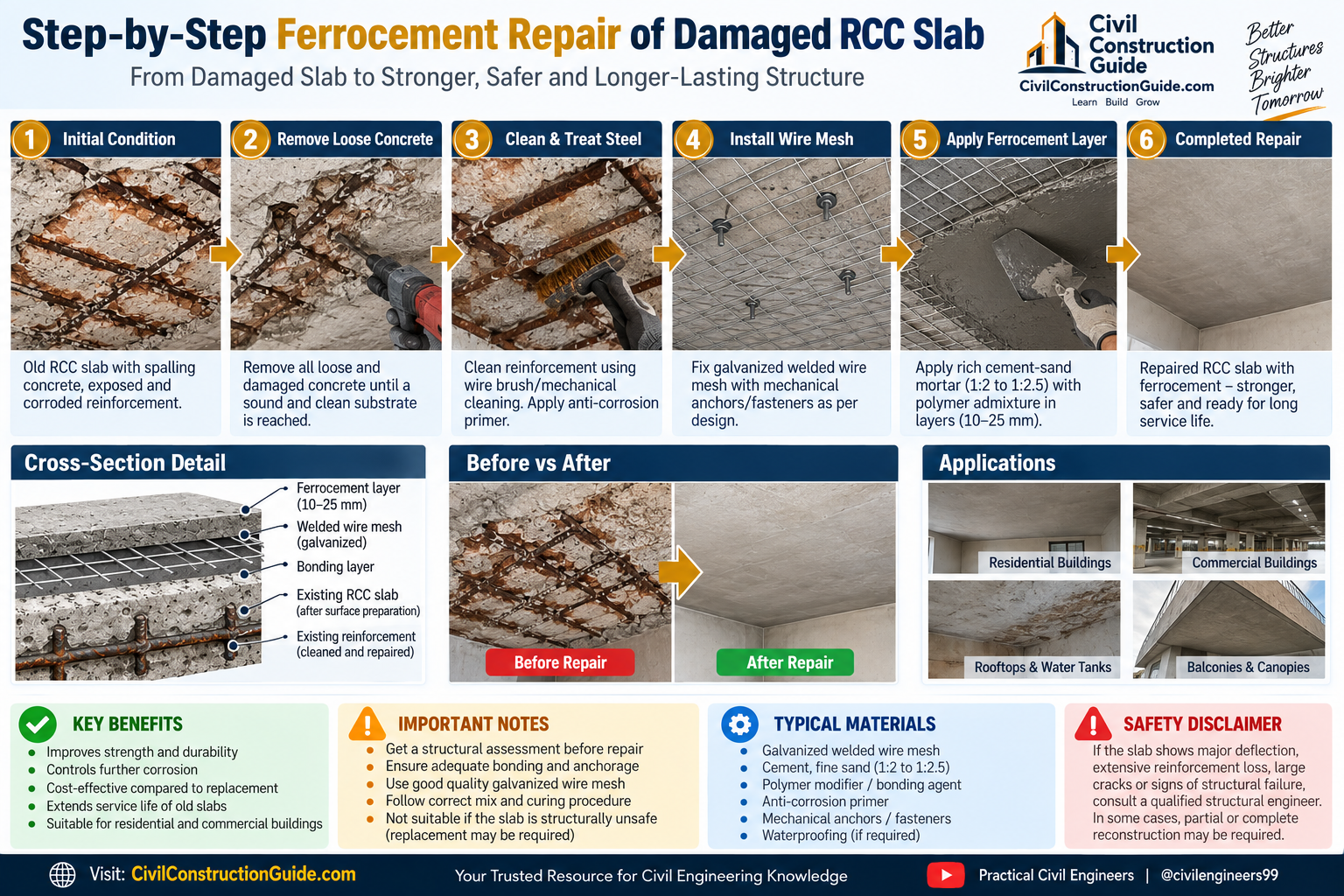
Step 1: Structural Assessment Before Repair
The first and most important step is determining whether the slab is suitable for rehabilitation. A structural engineer should examine the slab geometry, support conditions, crack pattern, deflection, concrete condition and reinforcement loss. Where necessary, testing may include sounding, cover measurement, reinforcement mapping, concrete strength assessment and corrosion-related testing.
Check the Remaining Reinforcement
Rust should not be judged only by appearance. The remaining diameter and cross-sectional area of important reinforcement should be assessed. If bars have suffered significant section loss, the engineer may specify supplementary reinforcement, anchorage or another strengthening method.
Check Cracks and Deflection
Wide structural cracks, progressive cracks, distress near supports or unusual deflection can indicate a problem that cannot safely be solved by applying ferrocement mortar alone. For additional guidance on identifying crack patterns, see our types of cracks in concrete and their remedies. The underlying structural cause must be identified first.
Step 2: Provide Temporary Support Where Required
If the slab is substantially deteriorated, temporary propping may be required before repair work starts. The arrangement and sequence should be determined for the actual structure. Removing large areas of damaged concrete without considering temporary support can further reduce the capacity of an already weakened member.
Step 3: Stop Water Leakage and Moisture Entry
Locate and correct the source of deterioration before completing the repair. For a roof slab, inspect waterproofing, rainwater drainage, cracks, pipe penetrations and ponding areas. For an intermediate floor, check bathrooms, kitchens and plumbing lines. A durable repair depends on controlling the moisture that caused or accelerated corrosion.
Step 4: Remove Loose and Unsound Concrete
All loose, delaminated and visibly unsound concrete should be carefully removed until sound substrate is reached. The repair perimeter should be prepared so the new repair material does not terminate against weak feather edges.
Work around reinforcement carefully. Aggressive breaking can damage bars or the remaining slab. The extent of removal should follow the repair specification and site assessment.
Step 5: Clean and Assess the Exposed Reinforcement
After damaged concrete is removed, corrosion products should be cleaned from exposed reinforcement using an appropriate mechanical cleaning method specified for the project. The objective is to expose a sound steel surface and allow proper inspection.
After cleaning, measure or otherwise assess the remaining bars. Reinforcement that has lost substantial section should not simply be covered again. Additional steel or another strengthening solution may be necessary according to structural calculations.
Step 6: Corrosion Protection and Interface Preparation
Where specified, an approved reinforcement corrosion-protection coating may be applied to properly prepared steel. The concrete substrate should also be cleaned of dust, laitance and loose material. Surface preparation and moisture condition must follow the selected repair mortar manufacturer’s technical data.
A compatible bonding treatment may be specified depending on the repair system. Product instructions are important because cementitious bonding slurries, polymer-modified systems and proprietary repair mortars can have different substrate requirements and application windows.
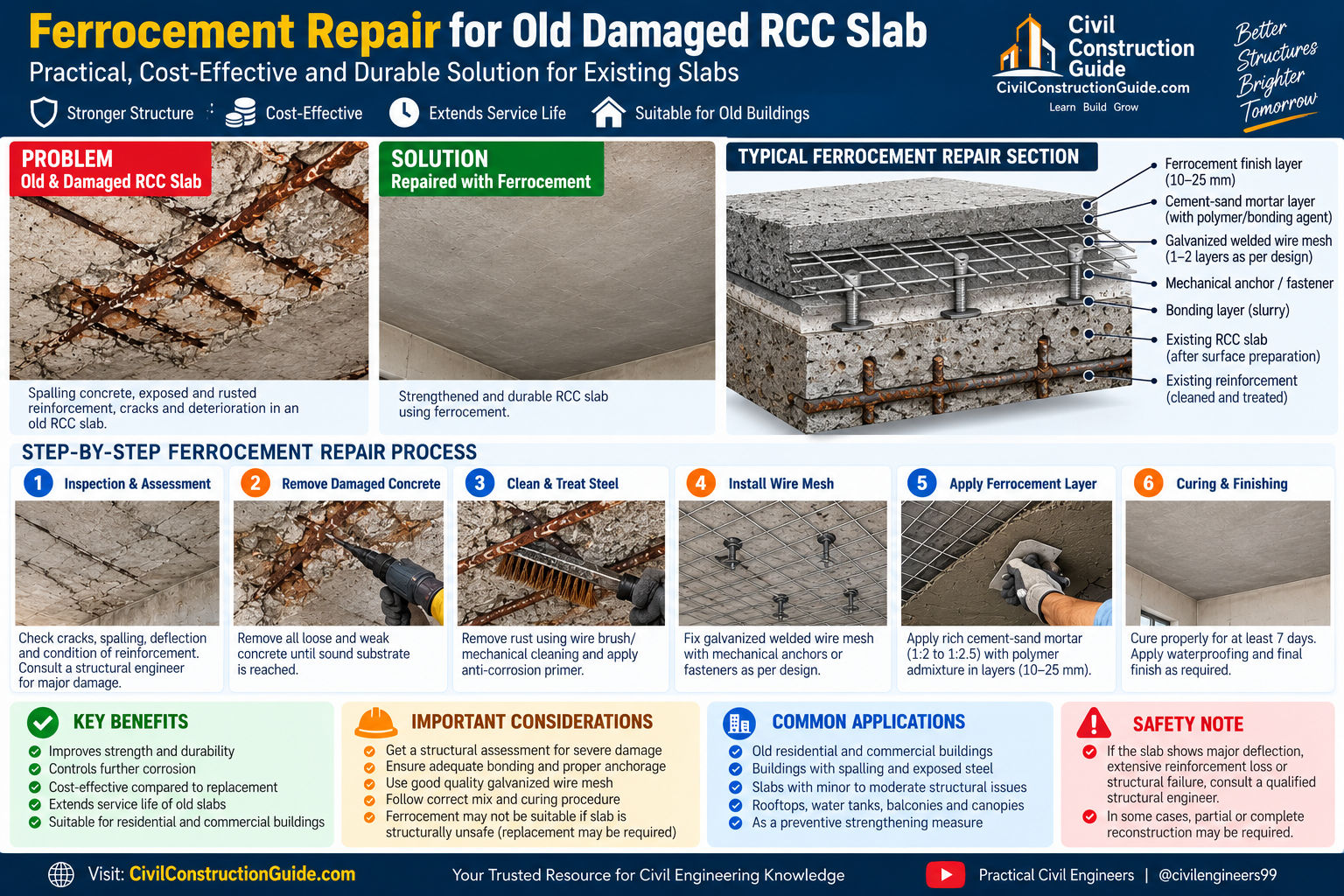
Step 7: Install Ferrocement Mesh and Anchors
The wire mesh is a key component of ferrocement rehabilitation. It must be securely fixed and positioned so it becomes properly embedded within the repair mortar rather than lying loosely against the old concrete.
The mesh type, wire diameter, spacing, number of layers, laps, edge details and anchor spacing should be specified by the structural engineer. Corrosion-resistant or suitably protected mesh may be considered according to exposure conditions and the selected system.
Why Anchoring Matters
Anchors or connectors help transfer forces and maintain the required relationship between the existing slab and the new reinforced repair layer. Poor anchorage can allow separation or debonding, which defeats the purpose of a composite strengthening system.
Step 8: Apply the Ferrocement Repair Mortar
Use a repair mortar suitable for structural concrete rehabilitation and the intended application thickness. If you need to estimate cement, sand and aggregate for other RCC works, our cement concrete calculator can help with preliminary quantity calculations. The mortar should be workable enough to fully encapsulate the mesh without excessive water addition. Excess water can increase shrinkage, reduce strength and adversely affect durability.
Apply the material according to the approved repair procedure, ensuring proper compaction around reinforcement, anchors and mesh. Voids behind the mesh should be avoided. Where the required thickness exceeds the permissible thickness of a single application, use the layer sequence recommended by the repair-material manufacturer.
Step 9: Finish and Cure the Repaired Surface
Correct curing is essential for cement-based repairs. For conventional RCC construction, you may also find our guide to deshuttering time for RCC slabs, beams and columns useful for understanding the importance of adequate strength development before support removal. Protect the repair from rapid moisture loss, direct sun, wind and premature loading. Follow the repair material manufacturer’s curing requirements. Poor curing can cause shrinkage cracking and reduce bond and durability.
Step 10: Restore Protective Measures
After the structural repair has achieved the required condition, restore the protection that prevents future moisture ingress. Depending on the slab location, this may include roof waterproofing, crack sealing, drainage correction or an appropriate protective coating. The repair should address both the damaged concrete and the environmental cause of deterioration.
Typical Repair Build-Up
A ferrocement rehabilitation detail may consist of the existing sound RCC substrate, retained and cleaned reinforcement, supplementary bars where structurally required, corrosion protection where specified, prepared bonding interface, mechanical anchors or connectors, securely fixed wire mesh, compatible repair mortar and a final protective system. The exact arrangement must be designed for the particular slab.
When Ferrocement Repair May Be Suitable
Ferrocement can be considered when an engineer confirms that the existing member is repairable and the proposed system can achieve the required bond, durability and strengthening objective. It can be useful for localized or distributed soffit rehabilitation where mesh reinforcement and a relatively thin cementitious layer are appropriate.
When Ferrocement Alone Is Not Enough
Do not assume ferrocement will make every damaged slab safe. Severe reinforcement section loss, excessive or increasing deflection, major structural cracking, damaged supports, widespread poor concrete, major punching or shear concerns, or uncertain load capacity can require a different solution. Depending on engineering assessment, alternatives can include conventional reinforced concrete strengthening, steel strengthening, externally bonded systems, partial reconstruction or complete slab replacement.
Common Mistakes to Avoid
- Applying fresh mortar directly over loose or rust-stained concrete.
- Covering corroded reinforcement without cleaning and assessing section loss.
- Ignoring roof or plumbing leakage that caused the deterioration.
- Fixing mesh without adequate anchorage or embedment.
- Adding excessive water to repair mortar.
- Providing inadequate curing.
- Removing large quantities of concrete from a weak slab without considering temporary support.
- Assuming a cosmetic repair has restored structural capacity.
Ferrocement Repair vs Complete Slab Replacement
Repair can preserve existing construction and may reduce demolition when deterioration is repairable. Replacement may be more appropriate when damage is extensive or reliable load-carrying capacity cannot economically be restored. The decision should be based on structural condition, durability, constructability, expected service life and total cost rather than appearance alone.
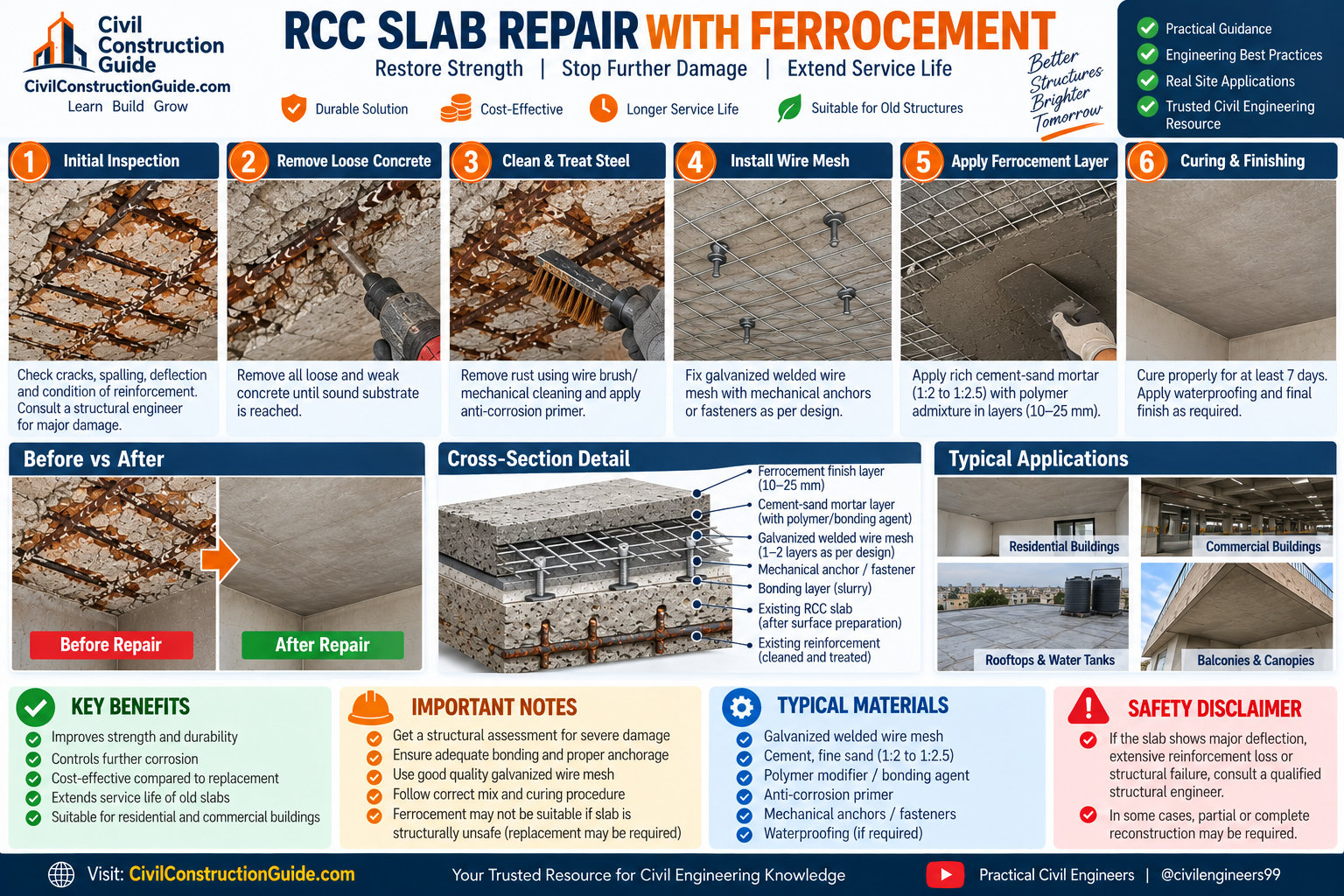
Quality-Control Checklist
- Confirm the source of moisture has been identified.
- Record cracks, spalling and reinforcement exposure before work.
- Remove unsound concrete to the specified limits.
- Clean and assess reinforcement before covering it.
- Install supplementary steel only according to approved details.
- Verify mesh type, laps, cover and anchor spacing.
- Use compatible repair materials within their specified application limits.
- Ensure full encapsulation and avoid voids.
- Follow the specified curing period and method.
- Inspect the completed repair before removing temporary support.
Frequently Asked Questions
Can ferrocement repair a badly rusted RCC slab?
It can form part of a rehabilitation system, but badly rusted reinforcement must first be cleaned and assessed for section loss. If the remaining reinforcement or concrete is inadequate, additional strengthening or slab replacement may be necessary.
Can I simply cover exposed steel with cement mortar?
No. Loose concrete and corrosion products need proper removal, the steel and substrate require assessment and preparation, and the repair material must be compatible with the existing concrete and exposure conditions.
Does ferrocement increase slab strength?
A properly engineered ferrocement system can contribute to strengthening and crack control, but the amount of improvement depends on mesh, anchors, material properties, geometry, bond and existing slab condition. Structural capacity should not be assumed without design calculations.
Should the slab be waterproofed after repair?
If water ingress contributed to deterioration, the source must be corrected. Roof slabs commonly require an appropriate waterproofing and drainage solution after structural repairs are completed.
How long will a ferrocement repair last?
Service life depends on the original damage, quality of surface preparation, reinforcement condition, repair material, workmanship, curing and control of moisture or other aggressive exposure. There is no reliable universal lifespan for every slab.
Final Thoughts
An old RCC slab with falling concrete and exposed, rusted reinforcement should be treated as a structural rehabilitation problem rather than a plastering problem. Ferrocement can be a practical technique in suitable cases, but successful rehabilitation begins with condition assessment, elimination of the deterioration source and an engineered connection between the existing slab and the new repair system.
For homeowners and site engineers, the safest approach is to have the slab inspected before deciding on repair thickness, mesh, anchors or additional reinforcement. A technically sound repair should restore durability without hiding unresolved structural damage.
Technical note: This guide provides general educational information for concrete rehabilitation. Actual repair and strengthening details must be developed for the condition, loads, dimensions, reinforcement and exposure of the specific structure.

Muhammad Bilal is a Civil Engineer and Construction Specialist with an MS in Engineering Management and 13+ years of professional experience. He shares practical construction knowledge, cost estimation, and RCC site expertise at CivilConstructionGuide.com.