
Introduction – What are Concrete Blocks?
Concrete blocks, also known as Concrete Masonry Units (CMU), are factory-manufactured masonry units made from cement, sand, aggregates, and water. Unlike traditional clay bricks, concrete blocks are larger, stronger, and more uniform, making construction faster and more economical.
Concrete blocks are widely used across the USA, Europe, Middle East, and Asia for residential, commercial, and industrial buildings.
Discover More
Property Tax Calculator Unit Converter Quantity Takeoff Sheets Construction Cost Calculator Building Materials House Plans Videos Concrete Calculator Column Steel Calculator1. What are Concrete Blocks? (Engineering Definition)
According to international construction standards, a concrete block is a precast masonry unit used in wall construction and bonded together using cement mortar.
Concrete blocks may be:
- Solid
- Hollow
- Lightweight
- Aerated
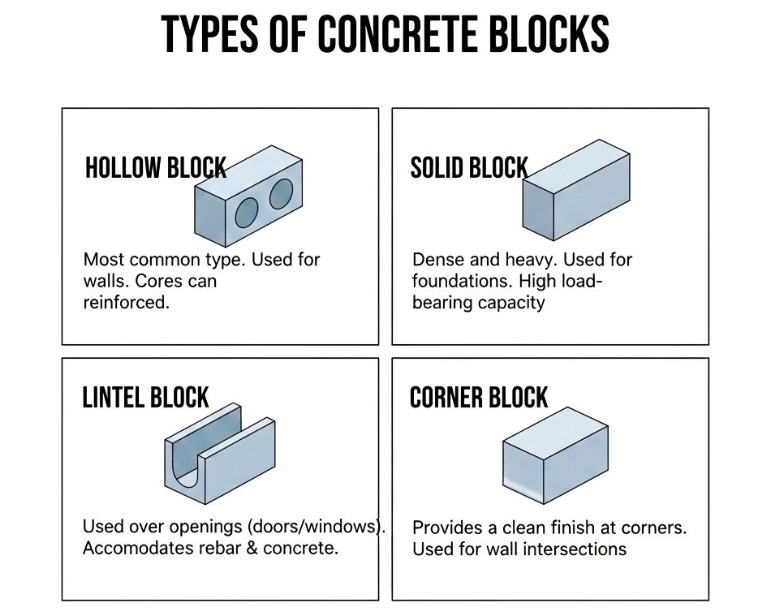
Their design allows:
✔ Reduced material consumption
✔ Better thermal performance
✔ Faster construction
2. Importance of Concrete Blocks in Grey Structure
Concrete blocks are increasingly replacing bricks due to:
✔ Faster wall construction
✔ Less mortar consumption
✔ Higher compressive strength
✔ Better dimensional accuracy
✔ Reduced structural load
In modern housing projects, concrete blocks are preferred for both load-bearing and partition walls.
3. Types of Concrete Blocks
a) Solid Concrete Blocks
Characteristics:
- Dense and heavy
- High compressive strength
Uses:
- Load-bearing walls
- Foundation walls
- Retaining walls
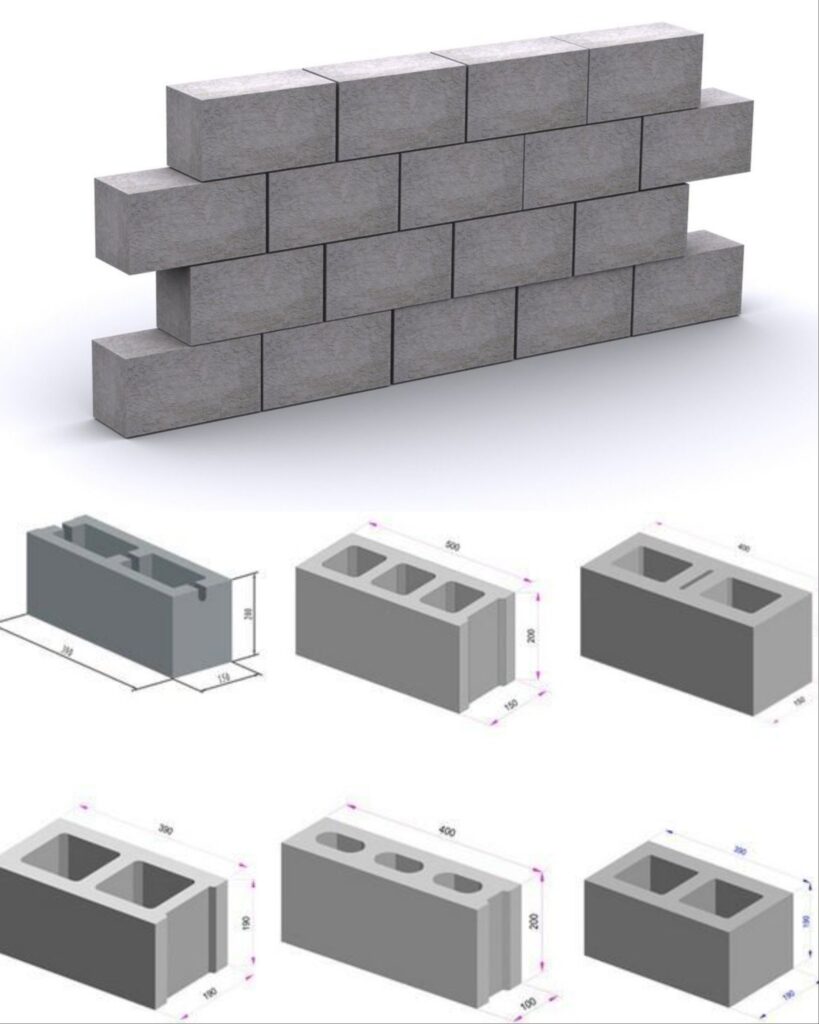
b) Hollow Concrete Blocks
Characteristics:
- 25–50% hollow space
- Lightweight
- Economical
Uses:
- External walls
- Internal partitions
- Multi-storey buildings
c) Lightweight Concrete Blocks
Characteristics:
- Made using lightweight aggregates
- Lower density
Uses:
- High-rise buildings
- Partition walls
Discover More
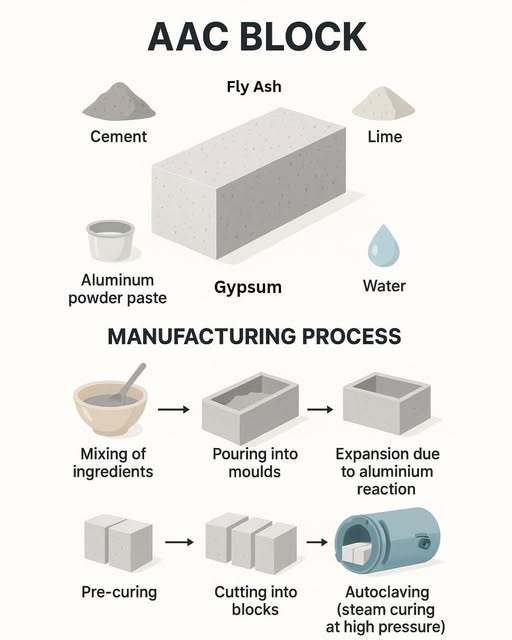
Property Tax Calculator Unit Converter Quantity Takeoff Sheets Construction Cost Calculator Building Materials House Plans Videos Concrete Calculator Column Steel Calculatord) Autoclaved Aerated Concrete (AAC) Blocks
Characteristics:
- Very lightweight
- Excellent thermal insulation
- Precise dimensions
Uses:
- Modern residential projects
- Energy-efficient buildings
4. Standard Sizes of Concrete Blocks
Pakistan & International Standard Sizes
| Block Type | Size (inches) |
|---|---|
| Standard Hollow Block | 16 × 8 × 8 |
| Partition Block | 16 × 8 × 4 |
| Solid Block | 12 × 8 × 4 |
| AAC Block | 24 × 8 × 4 / 6 |
📌 Thickness selection depends on wall load and design.
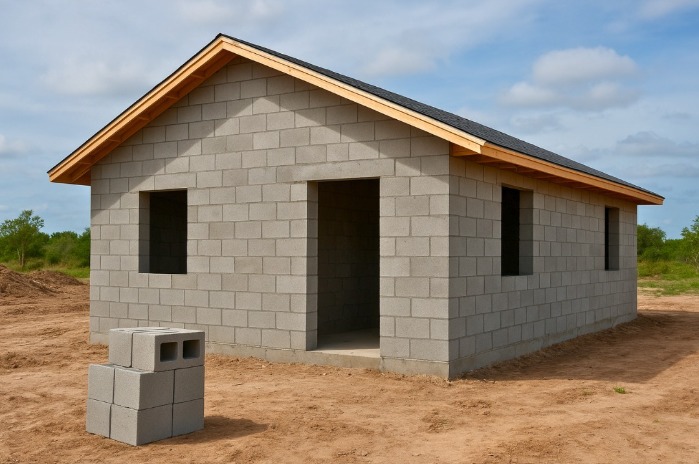
5. Uses of Concrete Blocks in Construction
✔ Load-bearing walls
✔ Partition walls
✔ Boundary walls
✔ Basement walls
✔ Fire-resistant structures
✔ Industrial buildings
6. Concrete Block Quantity Calculation
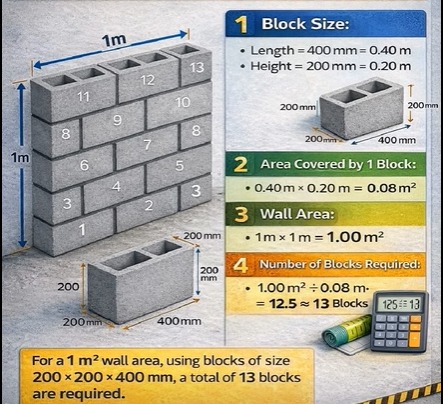
a) Blocks per Square Foot
For 16″ × 8″ block:
- 1.125 blocks per sq ft
👉 Click Here for Block Masonry Calculator
b) Blocks per 100 Square Feet Wall
| Wall Thickness | Quantity |
|---|---|
| 8″ Wall | 113 blocks |
| 4″ Wall | 113 blocks |
(Height remains same; thickness affects mortar & strength)
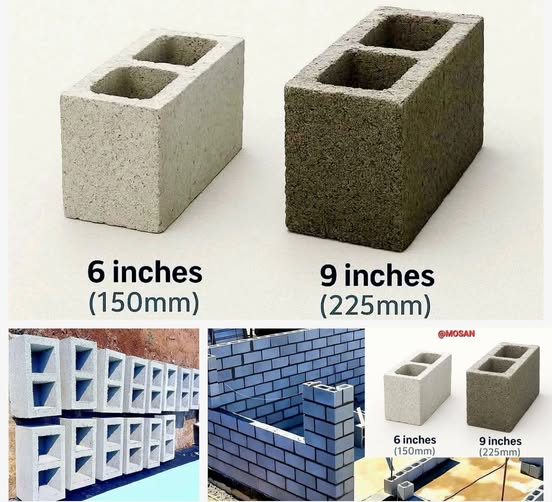
c) Mortar Requirement
For 100 blocks:
- Cement ≈ 1.2 – 1.5 bags
- Sand ≈ 0.2 – 0.25 m³
(Mortar ratio 1:6)
7. Mortar Ratios for Concrete Block Masonry
| Application | Ratio |
|---|---|
| Load-bearing walls | 1:4 |
| Partition walls | 1:6 |
| Boundary walls | 1:6 |
| Waterproof masonry | 1:3 |
8. Advantages of Concrete Blocks
✔ Uniform shape and size
✔ Faster construction
✔ Reduced plaster thickness
✔ Lower water absorption
✔ Better fire resistance
✔ Cost-effective for large projects
9. Disadvantages of Concrete Blocks
❌ Higher initial cost than bricks
❌ Requires skilled workmanship
❌ Less flexibility for small-scale work
10. Quality Tests for Concrete Blocks
Compressive Strength Test
- Must comply with ASTM / BS standards
Water Absorption Test
- Should not exceed 10%
Dimension Check
- Uniform size
- Sharp edges
11. Concrete Block Price in Pakistan — Listed Rates
| Block Type | Size | Rate (PKR) |
|---|---|---|
| Hollow Block | 16×8×8 | 180 – 220 |
| Hollow Block | 16×8×4 | 95 – 130 |
| Solid Block | 12×8×4 | 70 – 100 |
| AAC Block | — | 240 – 320 |
Price note: The table above contains indicative listed rates and should not be treated as a live quotation. Block prices vary by city, size, strength/grade, manufacturer, cement and aggregate costs, transport and order quantity. Confirm the current local supplier rate before purchasing.
12. Storage & Handling
✔ Store on flat surface
✔ Cover with plastic sheets
✔ Avoid dropping from height
✔ Cure masonry properly after construction
13. Common Mistakes to Avoid
❌ Using weak mortar
❌ Excessive joint thickness
❌ Not filling vertical joints
❌ Ignoring curing
14. Frequently Asked Questions (FAQs)
Q1: Are concrete blocks stronger than bricks?
Yes, concrete blocks generally have higher compressive strength.
Q2: Which block is best for houses in Pakistan?
16×8×8 hollow concrete blocks are commonly used.
Q3: Do concrete blocks reduce construction cost?
Yes, due to faster work and less mortar usage.
Master Blocks → https://masterblocks.com.pk
Diamond Concrete → https://diamondgroup.com.pk
Pak Block Industries → https://pakblocks.com
Conclusion
Concrete blocks are a modern, efficient, and durable alternative to traditional bricks. When selected and installed properly, they reduce construction time, material cost, and structural load while improving overall building performa

Muhammad Bilal is a Civil Engineer and Construction Specialist with an MS in Engineering Management and 13+ years of professional experience. He shares practical construction knowledge, cost estimation, and RCC site expertise at CivilConstructionGuide.com.
Pingback: How to Calculate Hollow Concrete Blocks for a 5 Marla House in Pakistan - Prime Crete
Pingback: How Many Hollow Blocks for a 10 Marla House in Pakistan
Pingback: 4 Inch Hollow Block Uses in Pakistan Homes