
Structural cracks are a serious concern in any building. Unlike non-structural cracks, they directly affect the strength, stability, and service life of a structure.
In this article, we’ll discuss the types of structural cracks, their causes, and practical remedies based on field experience.
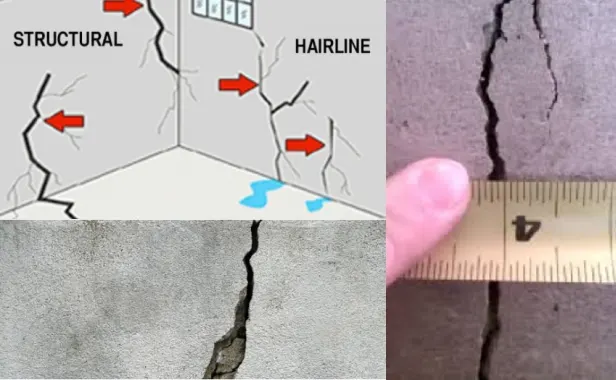
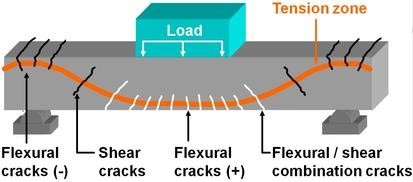
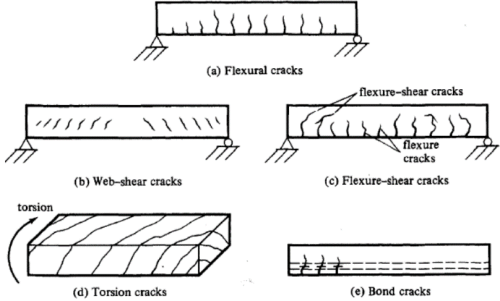
🔹 1. Flexural Cracks
Where Found: In reinforced concrete beams and slabs.
Appearance: Vertical or slightly diagonal cracks at the mid-span of beams or slab soffits.
Causes:
- Insufficient tensile reinforcement
- Overloading beyond design limits
- Incorrect placement of reinforcement
Remedies:
- Strengthen section with steel jacketing or FRP sheets
- Add additional reinforcement where required
- Reduce service load and check design calculations
🔹 2. Shear Cracks
Where Found: Near the supports of beams, lintels, or slabs.
Appearance: Diagonal cracks starting near the support, typically at 45°.
Causes:
- Inadequate shear reinforcement (stirrups)
- Overloading or impact loads
- Poor detailing or spacing of stirrups
Remedies:
- Provide additional stirrups or shear reinforcement
- Strengthen member with steel plates or FRP wrapping
- Ensure proper anchorage and concrete compaction near supports
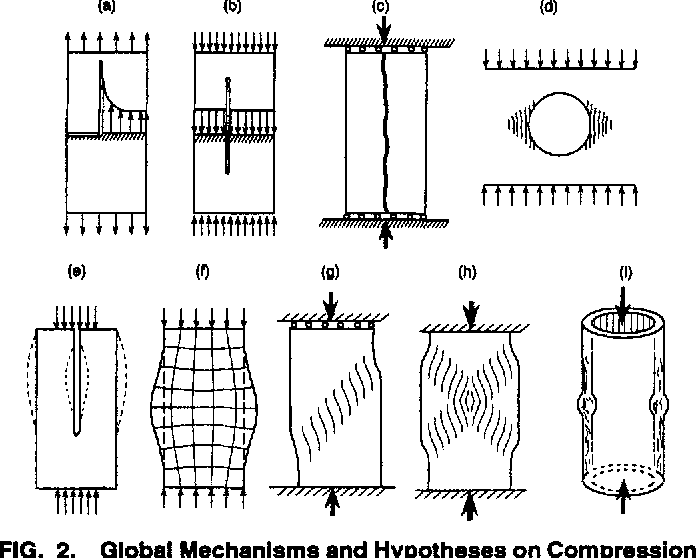
🔹 3. Compression Cracks
Where Found: In columns or load-bearing walls.
Appearance: Vertical cracks in the upper section of columns or walls.
Causes:
- Crushing of concrete due to overloading
- Inadequate cross-section area
- Low-strength concrete or honeycombing
Remedies:
- Jacketing the column with reinforced concrete
- Grouting and repairing damaged zones
- Strengthen foundation if overloading is due to settlement
🔹 4. Torsional Cracks
Where Found: In beams subjected to twisting (torsion).
Appearance: Diagonal cracks forming a spiral around the member.
Causes:
- Torsional moment not considered in design
- Asymmetrical loading or irregular supports
Remedies:
- Provide both longitudinal and closed stirrup reinforcement
- Modify structural design to reduce torsion
- Strengthen member using steel or FRP wrapping
🔹 5. Bond Cracks
Where Found: Along the line of reinforcement in beams, columns, or slabs.
Appearance: Cracks parallel to reinforcement bars.
Causes:
- Poor bonding between steel and concrete
- Rusting or improper concrete cover
- Inadequate compaction or vibration
Remedies:
- Use proper cover blocks and compaction
- Clean reinforcement before concreting
- Apply bonding agents or epoxy grout in repairs
🔹 6. Settlement Cracks
Where Found: In walls or columns connected to foundations.
Appearance: Vertical or diagonal cracks starting from bottom corners.
Causes:
- Differential settlement of foundation
- Weak bearing soil or poor compaction
Remedies:
- Strengthen foundation using underpinning or micro-piles
- Improve soil bearing capacity
- Repair cracks with epoxy injection after stabilization
🔹 7. Thermal and Shrinkage Cracks (Structural Impact)
Where Found: In long structural members exposed to temperature variations.
Appearance: Vertical or horizontal cracks, often near joints or connections.
Causes:
- Thermal expansion/contraction
- Lack of expansion joints
- Improper curing or temperature control
Remedies:
- Provide control and expansion joints
- Use low-heat cement and adequate curing
- Apply surface coatings to reduce temperature effect
✅ How to Identify a Structural Crack
- Width: Structural cracks are usually more than 2 mm wide.
- Depth: They extend through the full thickness of the member.
- Location: Found near supports, joints, or heavily loaded sections.
- Behavior: Continue to widen with time or load.
If a crack shows any of these signs, immediate inspection by a structural engineer is necessary.
⚙️ General Preventive Measures
- Follow proper design and detailing standards (ACI / BS / PEC).
- Use quality materials and adequate cover.
- Ensure proper curing and compaction.
- Conduct structural audits for old buildings.
- Avoid unauthorized modifications in structural members.
👷 Practical Civil Engineers’ Tip
“Not every crack is dangerous, but every crack is a signal. Structural cracks always tell a story — listen early, act early, and you can save the structure and cost.”
🧩 Read Also (Internal Links)
👉 Types of Cracks in Concrete and Their Remedies
👉 10 Marla House Construction Cost in Pakistan 2025
👉 Wooden Doors vs Fiber Doors | Cost Difference in Pakistan 2025

Muhammad Bilal is a Civil Engineer and Construction Specialist with an MS in Engineering Management and 13+ years of professional experience. He shares practical construction knowledge, cost estimation, and RCC site expertise at CivilConstructionGuide.com.
Pingback: Estimate of 3 Parallel Rooms Using Center Line Method | Complete Step-by-Step Calculation - Civil Construction Guide