
Introduction
Concrete workability is one of the most important factors affecting the quality, strength, and durability of any concrete structure. Among the various methods used to assess workability, the slump test is the most widely accepted and practically used test on construction sites. It provides a quick and reliable indication of the consistency of fresh concrete.
This article explains the slump test, its procedure, and the different values of slump for concrete used in various construction works. The content is written in a clear, educational, and original manner to comply with Google AdSense content quality guidelines, making it suitable for professional blogs and civil engineering learners.
What Is Slump Test?
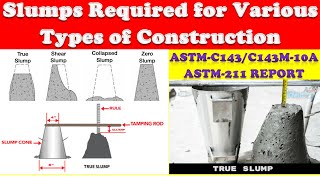
The slump test is a simple field test used to determine the workability and consistency of fresh concrete before placement. It measures how much concrete subsides or “slumps” after removing a standard cone mold.
This test is mainly performed at site to ensure:
- Uniformity of concrete mix
- Proper water–cement ratio
- Ease of placement and compaction
- Compliance with design requirements
Apparatus Used in Slump Test
These equipments are normally required for conducting slump test
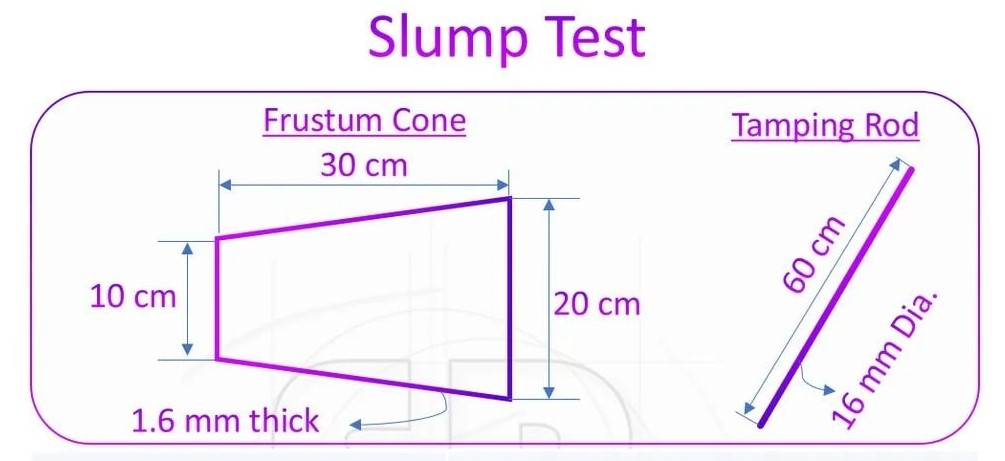
- Slump Cone (Abrams Cone)
- Height: 300 mm
- Bottom diameter: 200 mm
- Top diameter: 100 mm
- Tamping Rod
- Diameter: 16 mm
- Length: 600 mm
- Rounded at one end
- Base Plate (rigid and non-absorbent)
- Steel Scale for measurement
Slump Test Procedure (Step by Step)
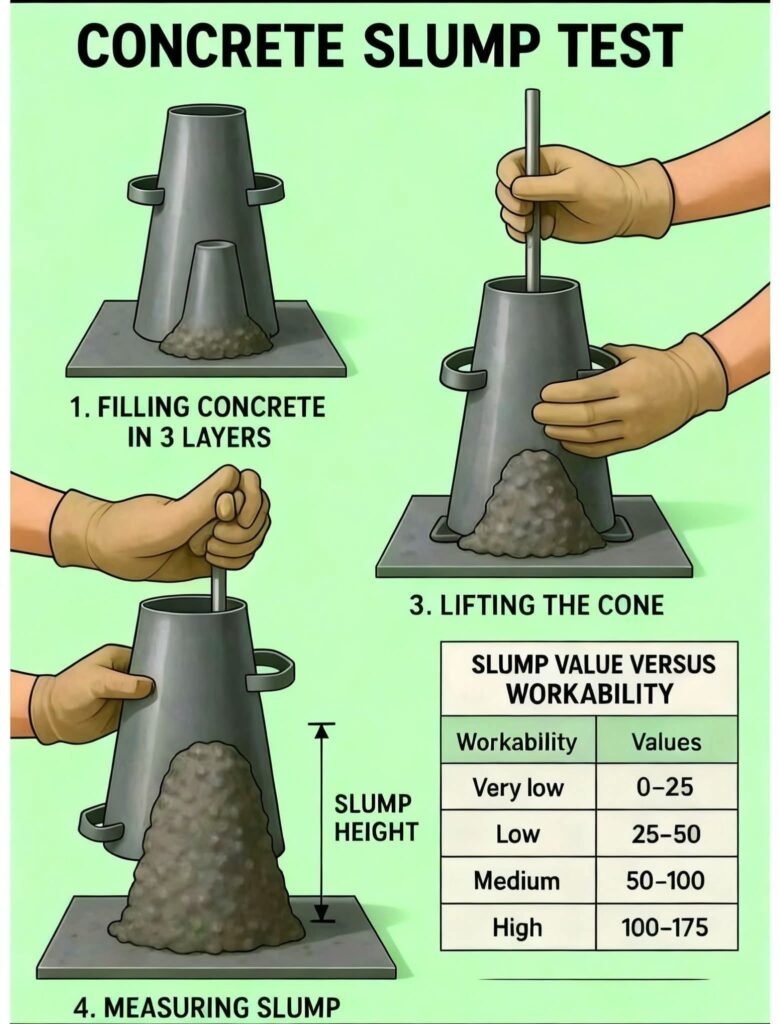
- Clean and moisten the slump cone and base plate.
- Place the cone firmly on a level surface.
- Fill the cone with fresh concrete in three equal layers.
- Each layer is tamped 25 times using the tamping rod.
- After the top layer, strike off excess concrete to make the surface level.
- Slowly lift the cone vertically upward.
- Measure the difference between the height of the cone and the height of the slumped concrete.
This measured value is known as the slump value, expressed in millimeters (mm).
Types of Slump
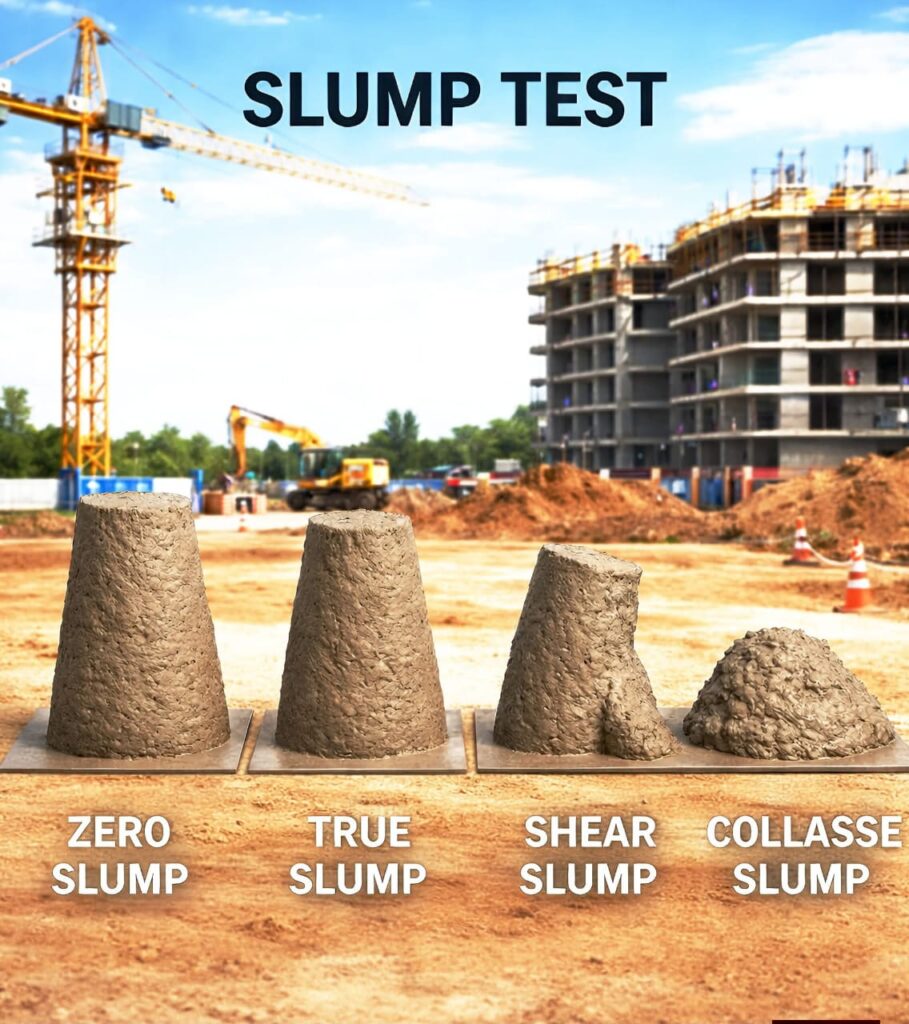
Based on the shape of concrete after removing the cone, slump can be classified into three types:
1. True Slump
- Concrete subsides uniformly
- Indicates good cohesion and proper mix
- Most desirable type
2. Shear Slump
- One side of concrete slips sideways
- Indicates lack of cohesion
- Mix needs correction
3. Collapse Slump
- Concrete collapses completely
- Indicates very high water content
- Test result is invalid
Different Values of Slump for Concrete
The required slump value depends on the type of construction work. Common recommended slump values are given below:
1. Very Low Workability Concrete
- Slump: 0 – 25 mm
- Used for: Road pavements, mass concrete, roller-compacted concrete
2. Low Workability Concrete
- Slump: 25 – 50 mm
- Used for: Foundations with light reinforcement, footings
3. Medium Workability Concrete
- Slump: 50 – 100 mm
- Used for: Beams, slabs, columns (normal RCC work)
4. High Workability Concrete
- Slump: 100 – 150 mm
- Used for: Heavily reinforced sections, congested steel areas
5. Very High Workability Concrete
- Slump: 150 mm and above
- Used for: Pumped concrete, self-compacting concrete (with admixtures)
Recommended Slump Values for Common RCC Works
| Type of Work | Recommended Slump (mm) |
|---|---|
| Footings | 25 – 50 |
| RCC Beams | 50 – 100 |
| RCC Slabs | 50 – 100 |
| Columns | 75 – 125 |
| Pumped Concrete | 100 – 150 |
| Mass Concrete | 0 – 25 |
Importance of Slump Test in Construction
The slump test plays a vital role in quality control because:
- It ensures consistent concrete quality
- Helps prevent segregation and bleeding
- Reduces chances of honeycombing
- Improves strength and durability of structure
- Saves cost by avoiding rework
Limitations of Slump Test
Although widely used, the slump test has some limitations:
- Not suitable for very dry or very fluid mixes
- Does not directly measure strength
- Results may vary with improper procedure
Conclusion
The slump test is a simple yet powerful tool for assessing the workability of fresh concrete. Understanding the different values of slump for concrete helps engineers, supervisors, and students select the right mix for different construction activities. Proper control of slump ensures quality construction, structural safety, and long-term performance.
This article is written purely for educational and technical purposes, with original content, clear structure, and real engineering value—making it suitable for Google AdSense–compliant blogs.
Frequently Asked Questions (FAQs)
Q1: What is the ideal slump value for RCC slab?
A: Usually between 50–100 mm, depending on site conditions.
Q2: Can high slump concrete be used everywhere?
A: You cannot use high slump every were it will cause segregation unless admixtures are used.
Q3: Is slump test compulsory on site?
A: It is highly recommended as part of routine quality control.
- Bana Banaya Ghar Khareednay Se Pehle Kya Kya Check Karna Chahiye? (Complete Guide)
- Ceramic Tiles – Complete Guide | Types, Uses, Sizes, Rates & Brands in Pakistan (2025)
- How to Select a Contractor? | Important Points Before Awarding Contract
- Complete Guide to Shuttering Plywood: Types, Uses, Quantity Calculation & Price in Pakistan (2025)
- Complete Guide to Binding Wire: Types, Uses, Quantity Calculation & Price in Pakistan (2025)

Muhammad Bilal is a Civil Engineer and Construction Specialist with an MS in Engineering Management and 13+ years of professional experience. He shares practical construction knowledge, cost estimation, and RCC site expertise at CivilConstructionGuide.com.