
Introduction
Every building, whether residential or commercial, is made up of several key components such as the foundation, walls, floors, roof, and finishes. These parts collectively form the civil works of a building.
Civil works include all construction activities that make a structure strong, stable, and functional. In addition, certain building services like water supply, sanitation, and electricity are integrated to make the building livable and comfortable.
In this complete guide, we will discuss the main components of a building, their purpose, and how each element plays a vital role in construction.
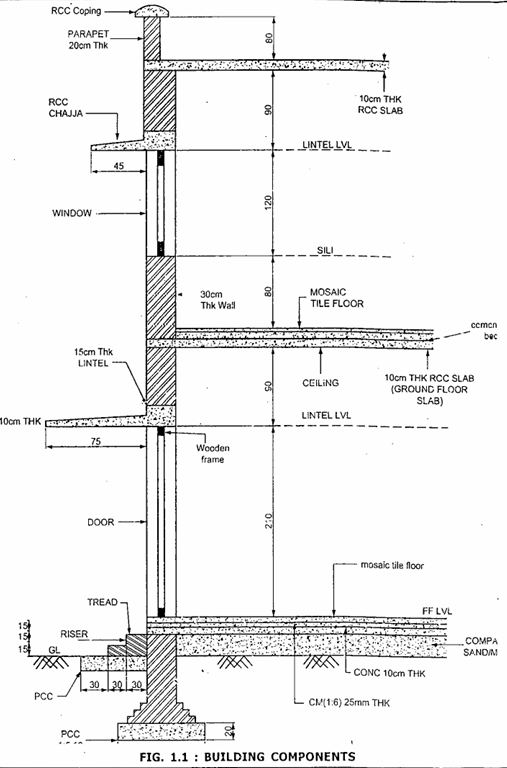
1. Foundation
The foundation is the lowest and most crucial part of any structure. It transfers the load of the entire building safely to the ground.
A strong and well-designed foundation ensures the durability and stability of a building.
👉 Learn More: [5 Marla Foundation Cost – Complete Guide]
2. Plinth
The plinth is the part of the building between the foundation and the floor level. It acts as a barrier against moisture and provides a raised platform for the superstructure.
A damp-proof course (DPC) is usually laid at the plinth level to prevent water from rising into the walls.
3. Walls and Columns
Walls and columns are the load-bearing and enclosing elements of a structure.
- Columns carry vertical loads from the slab and transfer them to the foundation.
- Walls provide enclosure, privacy, and protection from the environment.
👉 Also Read: [Block Masonry Construction Cost & Material Calculation]
4. Floors
The floor provides a working surface for occupants. It must be strong, level, and properly finished.
Floors can be made of concrete, tiles, marble, or wood depending on the type of building and use.
👉 Related Post: [Floor Finishing & Tile Work Cost Guide]
5. Lintels and Chajjas
- A lintel is a horizontal member placed over doors and windows to support the load of the wall above the opening.
- A chajja (sunshade) protects the wall from rain and sunlight, improving both durability and aesthetics.
6. Roof
The roof is the topmost covering of a building that protects it from weather effects such as rain, heat, and wind.
Common types include flat RCC roofs and sloping roofs depending on design and region.
👉 Watch Video: [10 Marla Slab Cost & RCC Work Details]
7. Doors and Windows
Doors and windows are essential for access, ventilation, and lighting.
They are made from materials such as wood, aluminum, steel, or UPVC. Proper placement and design improve both comfort and energy efficiency.
👉 Compare: [Wooden Doors vs Fiber Doors – Which is Better?]
8. Stairs and Lifts
Stairs connect different floors and must be designed for safety, comfort, and convenience.
In multi-storey buildings, lifts or elevators are also installed for vertical movement.
9. Finishing Works
Finishing gives the building an attractive and durable appearance. It includes:
- Plastering – Smoothens surfaces for painting.
- Painting & Distemper – Provides beauty and protection.
- Flooring & Skirting – Adds functionality and decoration.
👉 Learn More: [How to Calculate Paint and Weather Shield Quantity]
10. Building Services
Building services are systems installed within the structure to make it habitable, such as:
- Electrical systems
- Water supply and plumbing
- Sanitation and drainage
- Fire protection
- Air conditioning and ventilation
11. Fencing and External Works
External works include boundary walls, driveways, pavements, and landscaping around the building. These elements complete the project and enhance the aesthetic appeal.
Substructure and Superstructure
A building can be divided into two main parts:
- Substructure: The portion below ground level (foundation and plinth).
- Superstructure: The portion above ground level (walls, columns, roof, etc.).
Both sections are designed and supervised by qualified civil engineers to ensure strength, stability, and safety.
Final Thoughts
Every component of a building plays a vital role in ensuring the structure’s strength, durability, and functionality. Understanding these basic parts helps homeowners and engineers make better decisions during construction.
For detailed cost breakdowns, design guides, and construction videos — visit our YouTube channel Practical Civil Engineers or explore more articles on Civil Construction Guide.

Muhammad Bilal is a Civil Engineer and Construction Specialist with an MS in Engineering Management and 13+ years of professional experience. He shares practical construction knowledge, cost estimation, and RCC site expertise at CivilConstructionGuide.com.
Pingback: 10 Marla House Construction Cost in Pakistan 2025 - Civil Construction Guide