
Block masonry is one of the most commonly used construction techniques for residential and commercial projects. Whether you are building a boundary wall, room, or complete house, calculating the quantity of cement, sand, and concrete blocks accurately is essential for cost planning and material estimation.
To make this process fast and error-free, we have created a 100% free Block Masonry Calculator where you simply enter the wall dimensions and get the complete material breakdown instantly.
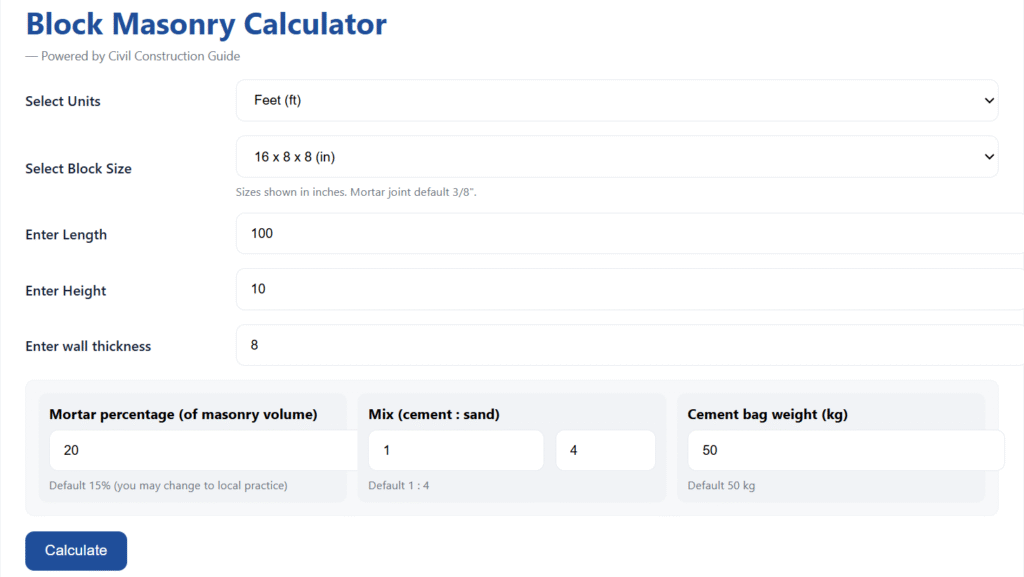
👉 Use the Calculator Here:
https://civilconstructionguide.com/block-masonry-calculator/
Why Accurate Block Masonry Calculation Is Important
Accurate estimation helps you:
- Avoid material shortage on site
- Reduce wastage
- Control project cost
- Improve work planning
- Achieve better quality masonry work
Most people either overestimate or underestimate block requirements. This calculator solves that problem by using standard engineering formulas and realistic mortar thickness.
Standard Block Size Used in This Calculator
The calculator uses the commonly available 16″ × 8″ × 8″ (inches) concrete block.
Block Size Without Mortar (Simple Method)
- Length: 16 inches
- Height: 8 inches
- Width/Thickness: 8 inches
Block Size With Mortar Joint (Detailed Method)
Mortar thickness = 3/8″ (10 mm) on all sides.
So the modified block dimensions become: L=L+mortar,H=H+mortar,W=W+mortarL = L + mortar,\quad H = H + mortar,\quad W = W + mortarL=L+mortar,H=H+mortar,W=W+mortar
This increases accuracy and reduces block quantity (because the effective size of each block increases).
How the Block Masonry Calculator Works
Our tool provides two methods:
Method A – Simple Method (Fast & Basic)
This method uses block size without mortar.
Formula
Number of Blocks=Wall VolumeBlock Volume\text{Number of Blocks} = \frac{\text{Wall Volume}}{\text{Block Volume}}Number of Blocks=Block VolumeWall Volume
Suitable for rough estimates.
Method B – Detailed Method (More Accurate)
This method includes mortar joint thickness, giving a more realistic block count.
Formula
Block Volume (with mortar)=(L+m)(H+m)(W+m)\text{Block Volume (with mortar)} = (L+m)(H+m)(W+m)Block Volume (with mortar)=(L+m)(H+m)(W+m)
Where:
- L = Block Length
- H = Block Height
- W = Block Width
- m = Mortar thickness = 3/8″
This method reduces the number of blocks needed and is preferred by quantity surveyors.
Step-by-Step Guide to Use the Calculator
- Open the calculator page.
- Enter the wall length in feet.
- Enter the wall height in feet.
- Enter the wall thickness (usually 8 inches).
- Choose Simple Method or Detailed Method.
- Click Calculate.
- Instantly you will get:
- Number of blocks
- Wall volume
- Cement quantity
- Sand quantity
- Mortar volume
Example Calculation
Let’s calculate for a wall:
- Length = 20 ft
- Height = 10 ft
- Thickness = 8 inch
Using Method B:
You will get approximately:
- Blocks Required: ~400–420 blocks
- Cement: ~1.5–2 bags
- Sand: ~0.20–0.30 cubic meter (or equivalent in cft)
(Exact values depend on mortar ratio and wastage percentage.)
You can try this yourself using the tool.
👉 Try the calculator now:
https://civilconstructionguide.com/block-masonry-calculator/
Advantages of Using This Calculator
- Instant results
- Engineering-based formulas
- Supports mortar thickness
- Highly accurate
- Useful for Quantity Surveyors, Engineers, Contractors & Students
- Mobile-friendly and easy to use
Frequently Asked Questions (FAQs)
1. What is the standard mortar thickness?
Usually 3/8 inch (10 mm).
2. How many blocks are required for 100 sq ft wall?
Approximately 135–150 blocks, depending on mortar thickness.
3. Which method is more accurate?
Method B (Detailed Method) because it includes mortar joints.
4. Can I use this calculator for hollow blocks?
Yes, if the size is the same. Otherwise, enter custom block dimensions.

Muhammad Bilal is a Civil Engineer and Construction Specialist with an MS in Engineering Management and 13+ years of professional experience. He shares practical construction knowledge, cost estimation, and RCC site expertise at CivilConstructionGuide.com.
Pingback: Paint & Distemper Quantity Calculator – Complete Guide (With Labour & Cost) - Civil Construction Guide
Pingback: Ceramic Tiles Complete Guide | Types, Uses, Sizes, Rates & Brands in Pakistan - Civil Construction Guide
Pingback: Bana Banaya Ghar Khareednay Se Pehle Kya Kya Check Karna Chahiye? (Complete Guide) - Civil Construction Guide