
Beams are one of the most essential structural members in civil engineering and Strength of Materials (SOM). They play a major role in supporting loads, transferring forces, and ensuring the stability of buildings, bridges, and all engineered structures.
In this detailed article, we will explain what a beam is, types of beams, functions, load behavior, examples, reinforcement basics, and real-life applications.
What is a Beam? (Definition)
A beam is a horizontal structural element designed to carry vertical loads, resist bending moments, and withstand shear forces.
Beams transfer load from slabs, walls, and roofs to columns or supports.
In simple terms:
👉 A beam is a member that takes load, bends, and safely transfers it to the supports.
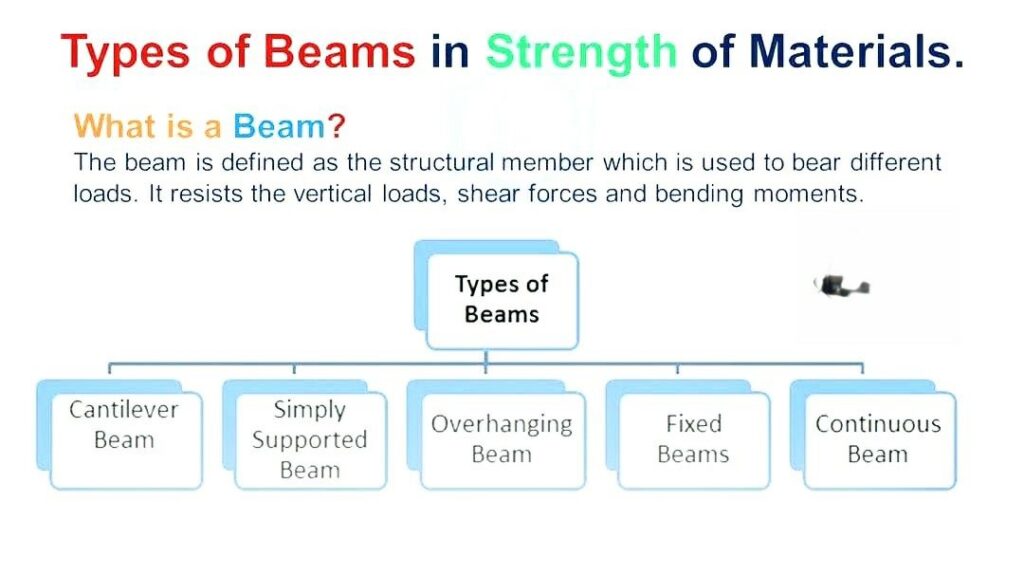
Why Beams Are Important in Construction
- To support slabs, roofs, and walls
- To distribute loads to columns
- To resist bending & shear
- To create open spaces without many columns
- To maintain building strength and stability
- Essential in earthquake-resistant design
Types of Beams (Based on Support Conditions)
According to the image, the most common beam types are:
1️⃣ Cantilever Beam
A cantilever beam is fixed at one end and free at the other.
Examples:
- Balcony
- Canopy
- Chajja
- Road signs
- Bridges
Key Features:
- Builds negative bending moment
- High tension on top fiber
- Needs strong reinforcement at support
2️⃣ Simply Supported Beam
Supported at both ends and free to rotate.
Examples:
- Residential beams
- Floor beams
- Short-span RCC beams
Key Features:
- Easy to construct
- Positive bending moment at mid-span
- Economical for small spans
3️⃣ Overhanging Beam
A beam with one or both ends extending beyond the support.
Examples:
- Verandas
- Small projections
- Platforms
Key Features:
- Mix of simply supported + cantilever behavior
- Generates both positive & negative moments
4️⃣ Fixed Beam
Fixed at both ends; cannot rotate or move.
Examples:
- Industrial structures
- Rigid frame buildings
- Heavy load structures
Key Features:
- Minimum deflection
- High bending resistance
- Difficult to construct
5️⃣ Continuous Beam
Supported on more than two supports.
Examples:
- Multi-storey buildings
- Long bridges
- Commercial structures
Key Features:
- Very economical
- Reduces bending moments
- Better load distribution
Load Types Acting on Beams
Beams carry and resist different types of loads:
- Dead load (self weight)
- Live load (people, furniture)
- UDL – Uniformly Distributed Load
- Point load
- Wind & seismic load
Internal Forces in Beams
- Bending moment (M) → causes bending
- Shear force (V) → causes diagonal cracks
- Deflection → downward bending of the beam
Materials Used for Beams
- RCC (Reinforced Cement Concrete)
- Steel
- Timber
- Composite
- Prestressed beams
- Precast beams
Beam Reinforcement Basics (RCC)
- Bottom main bars → resist tension
- Top bars → resist compression
- Stirrups → resist shear
- Cover → protects steel from corrosion
- Hooks (135°) ensure safety
FAQ Section (SEO Boost)
1. What is a beam in Strength of Materials?
A beam is a horizontal structural member that resists vertical loads, bending moments, and shear forces.
2. Which type of beam is strongest?
Fixed beams and continuous beams provide the highest stiffness and lowest deflection.
3. Where is a cantilever beam used?
Used for projections like balconies, canopies, and bridge arms.
4. What is the difference between simply supported and continuous beams?
Simply supported beams rest on two supports, while continuous beams span over three or more supports.
5. What causes bending moment in a beam?
External loads create bending forces inside the beam, which must be resisted using reinforcement.

Muhammad Bilal is a Civil Engineer and Construction Specialist with an MS in Engineering Management and 13+ years of professional experience. He shares practical construction knowledge, cost estimation, and RCC site expertise at CivilConstructionGuide.com.