
Beams are one of the most important structural elements in any building or infrastructure project. Whether it is a house, commercial building, school, bridge, or industrial structure, beams play a vital role in transferring loads safely to the foundations.
In this article, you will learn what beams are, their purpose, types, materials, design basics, reinforcement details, and practical site considerations.
🔹 What is a Beam? (Definition)
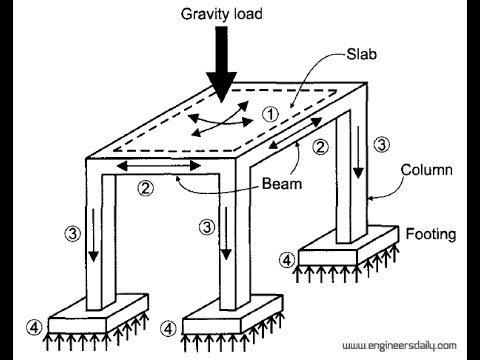
A beam is a horizontal structural member designed to carry and transfer loads from slabs, floors, and walls to columns or foundations.
It resists bending (flexural loads) and shear forces caused by the weight of the structure and external loads.
In simple words:
👉 A beam is a horizontal bar that supports weight and keeps the structure stable.
🔹 Function of Beams in a Building
Beams serve several important purposes in structural systems:
1. Load Distribution
Beams collect loads from:
- Slabs
- Roofs
- Walls
- Other beams
…and transfer them to columns.
2. Maintaining Structural Stability
Beams prevent excessive bending or collapsing of slabs and floors.
3. Increasing Span Capacity
They help slabs cover larger areas without support.
4. Providing Open Spaces
Beams allow creating:
- Large halls
- Rooms with wide spans
- Parking areas
- Open-plan structures
5. Resistance to Lateral Forces
Certain beams also help resist wind, earthquake, and lateral loads.
🔹 Types of Beams (According to Support Conditions)
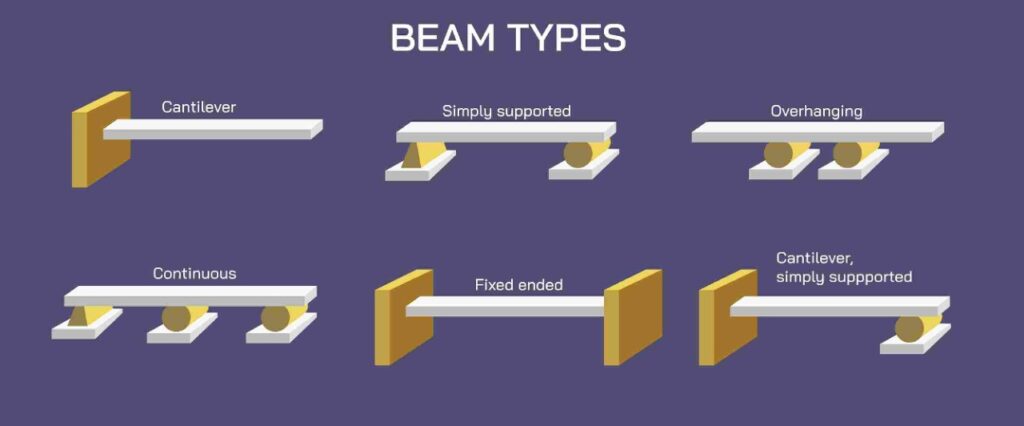
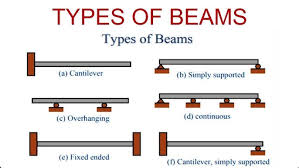
1. Simply Supported Beam
Supported at both ends and free to rotate.
Used in houses, small rooms, and normal span slabs.
2. Cantilever Beam
Fixed at one end and free at the other.
Examples:
- Balcony slabs
- Shade projections
- Canopies
3. Fixed Beam
Fixed at both ends and unable to rotate.
Used in rigid structures requiring stability.
4. Continuous Beam
Extends over more than two supports.
Used in large buildings because it reduces bending moments.
🔹 Types of Beams (According to Shape)
1. Rectangular Beam
Most common type in residential buildings.
2. T-Beam
Used where slab and beam act together (monolithic construction).
3. L-Beam
Used at slab edges.
4. I-Beam or H-Beam (Steel)
Used in steel structures, bridges, and factories.
🔹 Types of Beams (According to Material)
1. RCC Beam (Reinforced Cement Concrete)
Most widely used in houses and buildings.
Made of concrete + steel reinforcement.
2. Steel Beam
High strength, long spans, lightweight.
Used in high-rise buildings and industrial construction.
3. Timber Beam
Used in old houses and traditional construction.
4. Composite Beam
Combination of steel & concrete for high load structures.
🔹 Load Types Acting on Beams
Beams must resist different loads:
1. Dead Load
Self-weight of beam, slab, flooring, etc.
2. Live Load
Movable loads like people, furniture, etc.
3. Environmental Load
Wind, earthquake, temperature stresses.
4. Point Load & Distributed Load
- Point Load: Concentrated at one spot
- UDL (Uniformly Distributed Load): Spread evenly
🔹 Forces Acting on Beams
Beams experience:
1. Bending Moment
Causes beam to bend.
Rebars at bottom resist tension.
2. Shear Force
Occurs at the beam supports.
Stirrups resist shear cracks.
🔹 Components of a Beam
1. Main Bars (Longitudinal Bars)
Placed at bottom (tension zone) and sometimes at top (compression zone).
2. Stirrups (Shear Reinforcement)
Ties the main bars and resists shear.
3. Concrete Cover
Protects steel from corrosion and fire.
4. Anchorage & Development Length
Ensures proper bonding between concrete and steel.
🔹 Standard Beam Sizes in Residential Construction
Common sizes used in Pakistan:
| Span (ft) | Beam Size (inches) |
|---|---|
| 10–12 ft | 9″ × 12″ |
| 12–15 ft | 9″ × 15″ |
| 15–20 ft | 12″ × 18″ |
| > 20 ft | Designed beams with extra depth |
Note: Actual size depends on design and loading.
🔹 Beam Reinforcement Details
Main Bars
- Bottom bars: resist tension
- Top bars: resist compression (especially in continuous beams)
Stirrups
Common sizes:
- 3″ spacing near supports
- 6″ spacing at mid-span
Hooks
135° hook for stirrups as per standard design.
🔹 Common Beam Construction Mistakes (Must Avoid)
❌ Insufficient concrete cover
❌ Weak joints between beam and column
❌ Poor compaction or honeycombing
❌ Using undersized steel
❌ Incorrect stirrup spacing
❌ No curing after concreting
🔹 Importance of Beams in Earthquake-Resistant Construction
Beams help create a strong frame capable of resisting seismic forces.
Beam-column joints must be strong to ensure safety.
🔹 Difference Between Beams and Columns
| Parameter | Beam | Column |
|---|---|---|
| Orientation | Horizontal | Vertical |
| Primary Function | Carry loads to columns | Carry loads to foundation |
| Main Force | Bending & shear | Compression |
| Reinforcement | Bottom bars mainly | Uniform throughout |
Conclusion
Beams are essential structural elements that ensure the stability and safety of any building. From load transfer to structural support, beams form the backbone of modern construction. Understanding types, reinforcement, loads, and design considerations is crucial for civil engineers, contractors, architects, and students.
If you are in the construction field, a proper understanding of beams ensures safe design, quality construction, and durable structures.
Frequently Asked Questions (FAQs)
1. What is the purpose of a beam in a building?
A beam supports and transfers loads from slabs, floors, walls, and roofs to columns or foundations. It prevents bending and structural failure.
2. What are the common types of beams?
Simply supported beams, cantilever beams, continuous beams, fixed beams, rectangular beams, T-beams, steel beams, and composite beams.
3. What materials are beams made of?
Beams are commonly made of RCC (reinforced cement concrete), steel, timber, and composite materials depending on the structure.
4. What is the standard size of a beam in house construction?
For residential buildings in Pakistan:
- 9″ × 12″ for 10–12 ft span
- 9″ × 15″ for 12–15 ft span
- 12″ × 18″ for >15 ft span
(Exact size depends on structural design.)
5. What is the difference between a beam and a slab?
A slab provides a flat surface for flooring and roofing, while a beam transfers the slab’s load to columns.
6. What is the minimum reinforcement in an RCC beam?
Minimum steel area is 0.2% to 0.3% of the cross-sectional area depending on building codes.
7. Why are stirrups used in beams?
Stirrups prevent shear failure and hold the longitudinal bars in place.
8. What causes cracks in beams?
Common causes include insufficient reinforcement, poor concrete mix, overloading, improper curing, or low-quality construction practices.
9. Can beams be constructed without columns?
Yes, in certain load-bearing wall systems or truss systems, but for RCC structures beams are typically supported by columns.
10. What is a continuous beam?
A continuous beam spans across more than two supports, reducing bending moments and improving structural efficiency.

Muhammad Bilal is a Civil Engineer and Construction Specialist with an MS in Engineering Management and 13+ years of professional experience. He shares practical construction knowledge, cost estimation, and RCC site expertise at CivilConstructionGuide.com.